On the AMC 8, your score is simply the number of questions you answer correctly — a wrong answer costs the same as a blank one: zero. Because there is no penalty for guessing (per maa.org), leaving any bubble empty at the buzzer is throwing away free expected points. This guide walks through the exact scoring math — when a guess is worth it, when to invest a narrowing minute first, and how to run a clean final five minutes.
How the AMC 8 is actually scored
The rule is refreshingly simple, and understanding it changes how you spend your 40 minutes. The AMC 8 is a 25-question, multiple-choice paper. Each question offers five answer choices, conventionally labelled A through E. A correct bubble earns one point; an incorrect bubble earns nothing; a blank earns nothing. There is no negative marking and no partial credit. Your raw score therefore runs from 0 to 25, and it equals your correct-answer count — nothing more, nothing less.
That single design choice — wrong answers are not punished — is the hinge for every strategy decision below. On tests that do subtract for wrong answers (some national exams do), blank is sometimes the mathematically correct move. The AMC 8 is not one of those tests. Here, at the final buzzer, a blank is strictly worse than a guess. Confirm the current format, timing, and any rule updates on the official AMC pages at maa.org before your sitting, since organisers occasionally refine details.
| Outcome on one question | Points earned | Compared to leaving it blank |
|---|---|---|
| Correct answer bubbled | 1 | Better by 1 |
| Wrong answer bubbled | 0 | Identical (0 vs 0) |
| Left blank | 0 | — |
The expected-value math of a guess
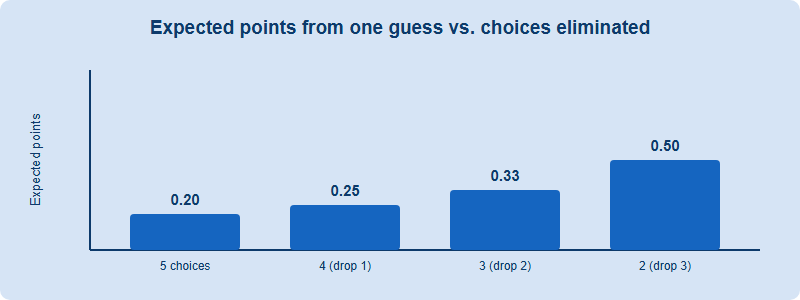
“Expected value” sounds advanced, but it is exactly the kind of reasoning the AMC 8 rewards, and you can do it in your head. Expected value (EV) is the average points a guess earns if you repeated it many times. With five equally likely choices and no penalty, a pure random guess wins one time in five:
- Blind guess among 5 choices: EV = 1 × (1/5) = 0.2 points. Small, but strictly positive — better than a blank’s 0.
- Eliminate 1 wrong choice (4 left): EV = 1/4 = 0.25 points.
- Eliminate 2 (3 left): EV = 1/3 ≈ 0.33 points.
- Eliminate 3 (2 left): EV = 1/2 = 0.5 points — a coin flip between two survivors.
The lesson is not “guess wildly.” It is that every wrong answer you can rule out roughly doubles or better the payoff of the eventual guess, so a few seconds of elimination on a hard question is high-leverage. Ruling out even one absurd choice lifts a blind 20% shot to 25%; getting down to two survivors turns it into a 50% shot. Across the 25 questions, those fractional points compound into whole points on your final score.
A concrete example of the arithmetic: suppose with two minutes left you have five questions untouched. Bubbling all five with pure random guesses has an expected gain of 5 × 0.2 = 1 point. Spend the first 90 seconds knocking each down to three plausible choices, then guess, and the expectation rises to about 5 × 0.33 ≈ 1.7 points. Same five questions, nearly double the expected reward — from disciplined elimination, not from solving anything fully.
A decision rule for each question
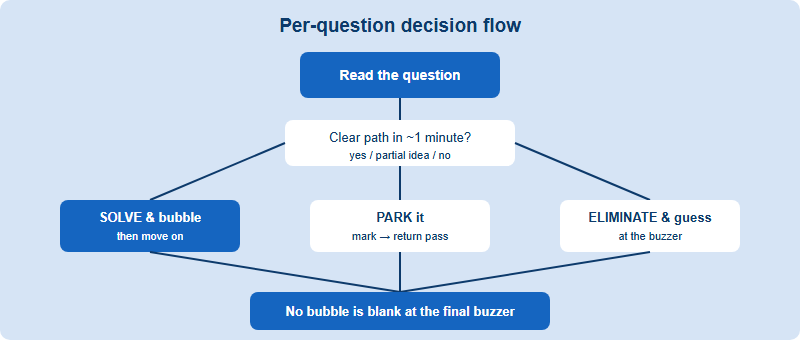
You do not want to compute EV mid-exam. Instead, internalise a simple triage that produces the same result. As you meet each question, sort it into one of three buckets, and let the clock decide when the buckets get resolved.
- Solve now (green): you see a path within roughly a minute. Do it, bubble it, move on. Do not linger to double-check a question you are confident about while others sit untouched.
- Park it (amber): you have an idea but it will take longer. Mark the question number on your scratch paper, bubble nothing yet, and return on a second pass. Parking protects your pace so the easy points at the back of the paper are not stranded behind one hard middle problem.
- Guess-later (red): no realistic path. Note any choices you can already eliminate as clearly wrong, then leave it for the endgame. You will come back with a narrowed field and a guess.
The reason to park rather than grind is that the AMC 8 does not weight questions by difficulty in the raw score — question 3 and question 23 are each worth exactly one point. So a minute spent finishing three easy questions is worth three times a minute spent on one brutal one. Difficulty rises across the paper, but the point value does not. Chase the cheap points first; reserve the hard ones for whatever time is left, then guess what you cannot finish.
Bubble-sheet discipline: where free points quietly die
The scoring is generous, but the answer document is unforgiving of small clerical slips. Because a machine (not a teacher) reads your bubbles, a mis-shaded or drifted answer can cost a point you genuinely earned. First-party observation from coaching Chinese international-school students: a meaningful share of “lost” points on the AMC 8 are not maths errors at all — they are transcription errors, off-by-one bubble drift after a skipped question, and unfinished bubbling when the buzzer catches a student mid-answer.
- Bubble as you go, not in a final rush. Transferring 25 answers in the last two minutes invites drift — skip one question and every bubble after it can land on the wrong row.
- When you park a question, physically skip its row too. Leave that row empty and keep your other answers aligned to their true question numbers.
- Fill fully and erase cleanly. Light or half-filled bubbles and ghost marks from erasures can confuse an optical reader. Bring a good eraser; pencils and a good eraser are what you need; calculators are not allowed. Confirm the current permitted-materials list on maa.org before your sitting.
- Reserve the last 3–5 minutes for the guess-later bucket. Walk your unanswered rows, apply your eliminations, and bubble something on every single one. Zero blanks is the target.
Think of the final five minutes as a distinct phase with its own job: not solving, but harvesting. Every red-bucket question gets a considered guess; every parked row gets resolved or guessed; every bubble is checked for alignment. Done well, this phase alone can be worth one to three points — the difference between score bands for many students.
Common misreadings of “no penalty”
Because the rule is so favourable, students sometimes over- or under-apply it. Two clarifications keep your strategy honest:
- “No penalty” is not “guess early.” Guessing is the correct move only after you have invested reasonable effort or run out of clock. Blowing through hard questions with instant random guesses to “save time” sacrifices the higher EV you would earn by eliminating first. Guess at the end, not the start.
- The rule can change; verify it. This article reflects the widely published AMC 8 format — 25 questions, 40 minutes, no calculator, one point per correct answer, no penalty for guessing. Always reconfirm the current rules, scoring, and any awards or cutoff details on maa.org and your registration page, because the AMC 8 is the entry tier of the US AMC ladder run by the MAA, and official policies are the authority.
One more framing to keep the strategy in proportion: the guessing math is a tie-breaker, not a substitute for preparation. It reliably converts effort into a slightly higher score by never wasting a bubble — but the bulk of your points still comes from actually being able to solve questions. Pair this scoring discipline with genuine topic practice, and you capture both the earned points and the free ones.
Frequently asked questions
Does a wrong answer on the AMC 8 lower my score?
No. Per maa.org, the AMC 8 has no penalty for guessing — a wrong answer scores the same as a blank (zero), so it never drags your total below where a blank would leave it.
Should I guess on every question I cannot solve?
Yes, but at the end. Eliminate any obviously wrong choices first to raise the odds, then bubble a guess. Leaving a question blank at the buzzer is strictly worse than guessing.
How many answer choices does each question have?
Each AMC 8 question is multiple choice with five options, conventionally A–E. A blind guess is therefore about a 20% shot; eliminating choices improves it. Confirm the current format on maa.org.
Is a calculator allowed to double-check answers?
No. Only writing utensils, blank scratch paper, rulers, and erasers are permitted; calculators, phones, and smartwatches are prohibited. Build mental-arithmetic fluency instead.
For related reading on the paper’s difficulty ramp and calculator-free technique, see our companion guides on the AMC 8 resource hub, and always cross-check the current rules on the official AMC pages at maa.org.
This is an independent guide operated by Hanlin Education for China-based international-school students. It is not affiliated with, endorsed by, or sponsored by the Mathematical Association of America (MAA). AMC 8 rules, scoring, formats, dates, and awards are set by the MAA — always confirm current details on maa.org and your registration page. Any error will be corrected within 7 working days.