A “good” AMC 8 score is best understood in context, not as a single number. The AMC 8 is marked out of 25 — one point per correct answer, with no penalty for a wrong or blank response. What turns a raw score into a meaningful result is the percentile it lands in and the recognition tier it earns, from Honor Roll up to a Certificate of Distinction. Exact thresholds shift each year, so always confirm current figures on maa.org.
How the AMC 8 Is Scored — and Why Guessing Is Free
The AMC 8 is a 25-question, 40-minute, no-calculator contest for students in grade 8 and under, sat in person during a January window (confirm the exact date and format on maa.org). The scoring rule is simple and important: each correct answer earns one point, and there is no deduction for a wrong answer or a blank. The maximum is 25.
That “no penalty” design changes how you should behave under time pressure. Because a blank and a wrong answer both score zero, a considered guess never costs you anything — it can only help. In our prep work with international-school students in China, one of the most common self-inflicted mistakes we see is leaving the final few questions blank “because there wasn’t time to solve them properly.” On the AMC 8, an unanswered question is simply a guaranteed zero. With roughly 96 seconds per question, the disciplined habit is to bank the questions you can solve, then make sure every remaining bubble is filled before time is called. For the registration windows and authorized-center logistics behind that January sitting, see our 2026–27 in-person AMC 8 guide.
Raw Score vs Percentile: Why 18 / 25 Isn’t a Fixed Grade
Here is the idea that reframes the whole “what’s a good score” question: the AMC 8 has no official pass mark. It is a percentile-based contest, and the difficulty of the paper varies from year to year. That means the same raw score can map to different percentiles in different years. An 18 in a harder year and an 18 in an easier year are not the same achievement, even though the number on the page is identical.
Practically, this has two consequences for how you read a result:
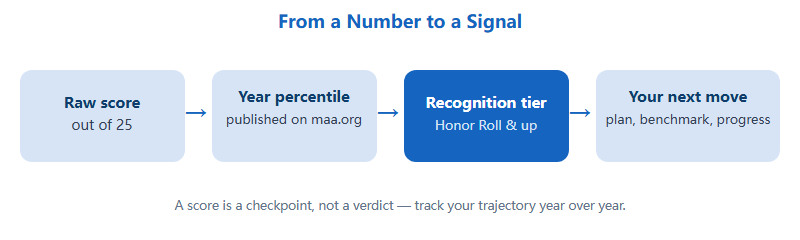
- Judge the percentile, not just the number. The MAA publishes summary statistics and score distributions each year on maa.org. Your percentile — the share of participants you finished ahead of — is a far more stable signal of where you stand than the raw count.
- Track your own trajectory. A student who moves from the 60th percentile one year to the 85th the next has demonstrably improved, regardless of whether the raw scores look dramatic. Year-over-year growth is the metric that actually reflects learning.
So when a parent asks us “is 20 out of 25 good?”, the honest answer is: it depends on the year and the field, and the useful comparison is against the percentile the MAA reports and against the same student’s previous result — not against a fixed cut-off that does not exist.
The Recognition Tiers, Explained
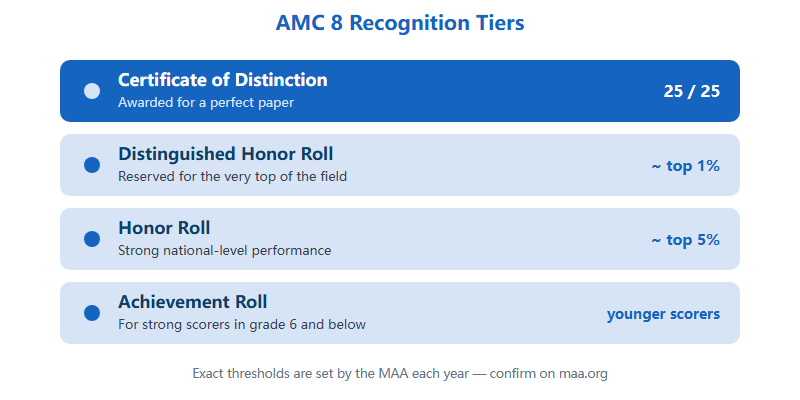
Above the percentile data sit the named recognition tiers. These are the awards that appear on certificates and that families most often want to understand. The tiers below reflect how the MAA structures recognition; the MAA sets the exact qualifying marks each year, so treat the percentile guidance as approximate and confirm current thresholds on maa.org.
| Recognition tier | Roughly who earns it | What it reflects |
|---|---|---|
| Certificate of Distinction | A perfect paper (25 / 25) | Flawless accuracy across all 25 questions |
| Distinguished Honor Roll | Approximately the top 1% of scorers | Elite performance relative to the national field |
| Honor Roll | Approximately the top 5% of scorers | Strong, competitive performance |
| Achievement Roll | Strong scorers in grade 6 and below | Recognition for younger students competing early |
Two details matter for international-school families in particular. First, the Achievement Roll exists precisely because the AMC 8 is open to younger students — a Grade 5 or Grade 6 competitor who scores well is recognized on a footing that accounts for age. Second, the Distinguished Honor Roll is deliberately narrow: being in the top 1% of a large national field is a serious result, and it is the tier most families are implicitly picturing when they imagine an “impressive” AMC 8 outcome.
What an AMC 8 Result Actually Signals
Once you know the raw score, the percentile, and any tier earned, the more useful question is: what does this result tell us, and what should it inform? An AMC 8 outcome is a signal, not a verdict. Read well, it points in three directions.
- Readiness for the next tier. A student consistently near the top of the AMC 8 is signalling that the entry tier no longer stretches them — a cue to consider the AMC 10 track when they reach the eligible grade band.
- A data point in a wider maths profile. For students building a record of mathematical engagement, an AMC 8 result is one line among many — useful, but strongest when it sits alongside sustained coursework, other activities, and a clear upward trend.
- An honest self-benchmark. The percentile shows where a student stands nationally and where the next block of improvement lies.
A caution we repeat often: no AMC 8 result guarantees admission to any school or programme, and none guarantees success at a higher tier. Selective programmes read competition results in context, alongside everything else a student does. Treat a strong score as evidence of momentum to build on, not a finish line.
It is also worth separating two different audiences for a result. For the student, the value is diagnostic — the percentile and the pattern of missed questions tell them exactly what to train next. For a wider profile, the value is corroborative: an AMC 8 result rarely stands alone, and it reads best when it confirms a story the rest of a student’s record is already telling. Neither audience is well served by treating a single sitting as decisive. The students who benefit most are those who return each year, because a rising line across two or three papers is far more persuasive — to themselves and to anyone else — than one strong number in isolation.
How China-Based International-School Students Should Read Their Score
For families at international schools in China, a few habits make the AMC 8 result far more useful than a bare number.
Anchor on the percentile, not the mark. Because the paper’s difficulty and the field both change annually, the percentile the MAA reports is the honest comparison. It travels across years; the raw number does not.
Use the grade band to your advantage. Many international-school competitors sit the AMC 8 in Grade 6 to Grade 8. A younger student posting a strong result — potentially earning Achievement Roll recognition — is on an encouraging trajectory even if the raw score is not yet Honor Roll. Confirm the current Achievement Roll criteria on maa.org.
Plan the next 12 months around the trend, not the trophy. The most productive question after results day is not “was that good?” but “where did the lost points cluster, and what will we do differently before the next January sitting?” That is also the moment to confirm registration timing through an authorized center — the practical steps are laid out in our 2026–27 in-person AMC 8 guide. A student who treats each result as a checkpoint, tightens the weak domains, and returns the following year almost always reads better on the page and on the percentile chart.
One more habit worth building early: keep a simple record of each year’s raw score, reported percentile, and the domains where points were lost. Over two or three sittings that record becomes a personal trend line that is far more informative than any single result — and it turns the “what should we do next?” conversation into something concrete rather than anxious. Confirm each year’s reported statistics on maa.org so the comparison stays apples-to-apples, and let the trajectory, not one number, guide the plan.
Hanlin AMC 8 Results: 2025-26 Counts and Their Scope
For the 2025-26 AMC 8 season, Hanlin Youfang reported outcomes for its coached students and test-center participants. The data shows 103 Distinguished Honor Roll placements (top 1%), 96 Honor Roll placements (top 5%), and 101 results in the top 10%. These figures are first-party observations from our internal records, not MAA-wide statistics.
| Recognition Category | Reported Count | Approximate Percentile Band |
|---|---|---|
| Distinguished Honor Roll | 103 | Top 1% |
| Honor Roll | 96 | Top 5% |
| Top 10% Results | 101 | Top 10% |
It is critical to understand that these categories are source-reported labels. The counts cannot be summed to establish a reliable unique total number of successful students, nor can they be used to calculate a success rate. The population includes both coached students and those testing at Hanlin centers. Categories cannot be assumed mutually exclusive; overlaps between award tiers are not explicitly defined in the report. Consequently, the “top 1,” “top 5,” and “top 10” labels reflect historical source categorizations rather than fixed numerical thresholds for this specific group.
To assess your own score effectively, do not compare against these aggregate counts. Instead, locate your raw score on the official MAA percentile chart for the current year. Identify which recognition tier your percentile falls into, then analyze the specific question types where points were lost. This diagnostic approach provides actionable insight for future preparation, whereas comparing against a non-representative sample of competitors offers little predictive value for individual improvement.
Frequently Asked Questions
Does the Hanlin cohort data represent all AMC 8 participants?
No. The data reflects only Hanlin Youfang's coached students and test-center participants for the 2025-26 season. It is not a representative sample of all competitors.
Can I add the 103, 96, and 101 counts to find the total number of awardees?
No. The source does not confirm whether these categories are mutually exclusive or how many students appear in multiple bands. Summing them cannot establish a reliable unique total.
Is there a passing score for the AMC 8?
No official pass mark exists. The AMC 8 is a percentile-based contest scored out of 25, and recognition tiers are set by the MAA each year. Confirm current details on maa.org.
How many points is each AMC 8 question worth?
One point per correct answer, with no deduction for a wrong or blank answer, for a maximum of 25. Confirm the current rules on maa.org.
What is the AMC 8 Distinguished Honor Roll?
Recognition for students in roughly the top 1% of scorers. The MAA sets the exact threshold each year, so confirm the current figure on maa.org.
Does a high AMC 8 score guarantee admission or AMC 10 success?
No. It is a helpful signal of readiness and momentum, not a guarantee. Use it to plan next steps and confirm pathways on maa.org.
This is an independent guide operated by Hanlin Education for China-based international-school students. It is not affiliated with, endorsed by, or sponsored by the Mathematical Association of America (MAA). Competition details change — always confirm current dates, eligibility, scoring, and recognition thresholds on maa.org. Any error will be corrected within 7 working days.