Working through more past papers is not practice. The loop that actually moves an AMC 8 score has four phases: an untimed diagnostic, a strictly timed mock, an error log that sorts every mistake by cause rather than by topic, and a scheduled redo of the same questions cold. Most families run phase two and skip the rest — which is why fifteen papers can leave a score exactly where it started.
The metric almost every family uses is the wrong one
Ask a family in October how preparation is going and the answer is usually a number of papers. Eight done, four to go. It is a comfortable metric because it moves every week and it feels like effort.
It is also close to useless as a predictor. The number that actually forecasts a January result is different: how many previously-failed problems can this student now solve cold, from the question alone, three weeks later? That number can sit at zero while the paper count climbs, and when it does, the score does not move. We see this pattern every season, and it is almost always the same story — a student who has done a great deal of work and made very little progress, because none of the work closed a loop.
Consider what happens mechanically when a student does a paper, checks answers, reads the solutions to the six they missed, nods, and moves to the next paper. Every one of those six problems was, at the moment of reading, understood. None of them was reconstructed. Understanding a solution you are looking at and generating one you cannot see are different skills, and only the second is on the exam. Reading solutions builds the first and quietly convinces everyone that the second happened too.
So the protocol below is built around one rule: a problem is not finished when you understand the solution. It is finished when you can produce the solution again, from scratch, after enough time has passed that you have forgotten it.
The four-phase loop
One paper, run properly, is roughly two and a half hours of work spread over three weeks. That sounds like a lot until you compare it with three papers run badly, which is four hours and produces nothing durable. Three weeks per paper also sets a hard limit on how many you can fit before the in-person January sitting, which is a good reason to fix the exam date first — see our registration and test-centre guide and confirm the current window on maa.org.
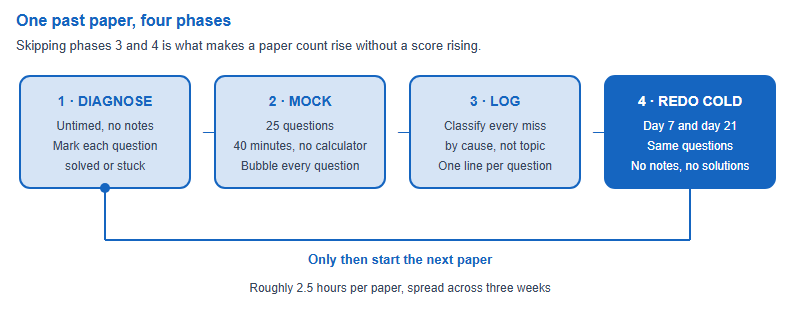
A few details in the protocol matter more than they look.
- Phase 1 comes before phase 2, not after. Doing the paper untimed first tells you what the student can do with unlimited thinking. Doing it timed afterwards tells you what survives 96 seconds a question. The gap between those two numbers is the single most useful diagnostic in AMC 8 preparation — and it is invisible if you only ever sit timed mocks.
- Phase 2 must be genuinely strict. 25 questions, 40 minutes, no calculator, one sitting, phone in another room. A mock with a five-minute interruption is not a mock; it is a worksheet with a timer on it, and it will over-report the score.
- Every question gets an answer in phase 2. AMC 8 scoring awards one point per correct answer with no penalty for a wrong one, so a blank is a discarded point — confirm the current rules on maa.org. Practising the paper the way it is scored is part of the point of a mock.
- Phase 3 happens the next day, not the same evening. A student who has just sat a timed paper is not in a state to analyse their own thinking honestly.
The error log: five causes, five different fixes
This is the part that carries the value, and it is the part almost nobody does properly. Most error logs sort mistakes by topic — three geometry, two counting, one ratio. That grouping feels organised and prescribes the wrong medicine, because two students can both miss three geometry questions for completely different reasons and need completely different work.
Sort by cause instead. There are five, and each has its own fix.
| Cause | How to recognise it | The fix | What does NOT fix it |
|---|---|---|---|
| 1 · Unknown | You had no idea what the question was asking for, even with unlimited time | Learn the topic properly — this is a content gap, not a paper gap | More past papers |
| 2 · Wrong method | You knew the material but attacked it the slow or wrong way | Redo it and write the method name first, before any working | Reading the official solution and nodding |
| 3 · Execution slip | Correct approach, arithmetic or sign error on the way | Slow the writing down, not the thinking; work vertically, one step per line | Telling the student to “be careful” |
| 4 · Misread | You solved a real question, just not the one on the page | Circle every constraint word; re-read the final sentence before bubbling | Any amount of extra maths |
| 5 · Pacing | You could have solved it, but the clock ran out | Triage drill: a hard cap per question, then move on and return | Learning more content |
Run this for two papers and the shape of the problem usually becomes obvious. A student whose log is mostly cause 1 needs to stop sitting mocks and go back to topic work. A student whose log is mostly causes 3 and 4 already knows enough mathematics to score well and is losing points to handwriting and haste — which is genuinely good news, because those are the fastest points in the whole preparation. A student whose log is mostly cause 5 has a triage problem, and adding content will make it worse, not better.
Keep the log to one line per missed question: paper, question number, cause number, and a five-word note on what you would do differently. Long reflective write-ups look impressive and get abandoned by week three.
Redoing cold: what ‘cold’ means, and why day 7 and day 21
A redo only counts if the student cannot remember the answer. That means: the original working is not visible, the solution has not been re-read that morning, and enough time has passed that recall has genuinely faded. Re-solving a problem two hours after reading its solution measures memory, not ability, and it produces a very pleasant and completely misleading sense of progress.
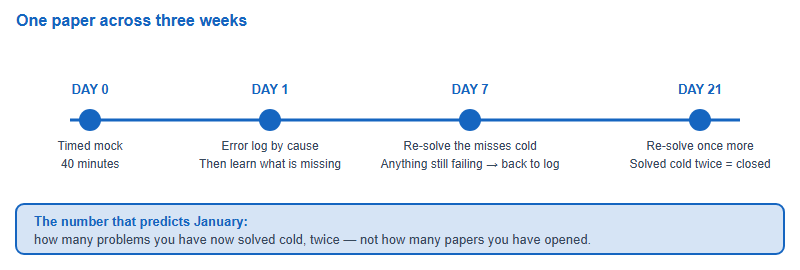
Day 7 and day 21 are not magic numbers, but the principle behind them is well established: material recalled after a gap sticks far better than material reviewed immediately. The practical version is simply that the second attempt should feel slightly uncomfortable. If it feels easy, the gap was too short and the redo has told you nothing.
Two rules keep this honest. First, a redone paper never produces a score — the moment a student has seen a paper, its score is contaminated and quoting it is self-deception. Track redos as a count of problems closed, never as a mark out of 25. Second, if a problem fails at day 7, it goes back to the log with a fresh cause classification. Failing twice for the same reason usually means the original diagnosis was wrong: what looked like a careless slip was actually a shaky method.
Sequencing your supply of papers into January
Past papers are a finite resource and most families spend them in the wrong order — opening the newest and most representative material in September, when the student is least able to learn from it, and arriving at December with nothing clean left to calibrate against.
Sequence it deliberately. The plan below assumes an autumn run into the January window; check the current dates on maa.org and, if a seat is still outstanding, work backwards from our in-person registration and test-centre guide before fixing the calendar.
| Stage | Which papers | How to run them | Why this order |
|---|---|---|---|
| Build (early autumn) | Older material | Untimed, by topic, solutions available | Style differences matter least here; you are learning content |
| Convert (mid autumn) | Mid-vintage papers | Full four-phase loop, one paper a fortnight | Enough repetitions to make the error log show a pattern |
| Calibrate (late autumn to December) | The most recent papers you have | Strict mock conditions, one a week | Closest to current style; you now have the skill to learn from them |
| Taper (final week) | Nothing new | Re-solve closed problems only, short sessions | New failures this late add anxiety, not points |
Hold two unseen papers in reserve throughout. They are your only clean read on where the student actually stands in December, and once a paper has been seen it can never give you that reading again.
On sourcing: we maintain our own gathered and organised set of AMC 8 material for students we work with — past papers with answer keys, and worked solutions for a number of the years rather than all of them, since we are still adding to it. What is included in any given pack is whatever our teachers send at the time; families can ask us for it through the AMC 8 study package page. Whatever set you use, the protocol above matters far more than the size of the collection. Six papers run through four phases will outperform twenty papers read once, and it is not close.
Frequently Asked Questions
How many AMC 8 past papers should my child do?
Six to ten run through the full loop is plenty. Papers opened once and marked do not build anything, however many there are.
Should mocks be timed from the start?
Do the first pass untimed, then a strict 40-minute run. The gap between the two scores tells you whether the problem is knowledge or pace.
Is it cheating to redo a paper my child has already seen?
No — redoing is the point. Just never treat the second score as a real score; it measures memory as much as ability.
My child understands every solution but still scores the same. Why?
Understanding a solution you can see is a different skill from producing one you cannot. Only spaced cold redos build the second.
This is an independent guide operated by Hanlin Education for China-based international-school students. It is not affiliated with, endorsed by, or sponsored by the Mathematical Association of America (MAA). Competition details change — always confirm current dates, eligibility, format, scoring and registration arrangements on maa.org. Any error will be corrected within 7 working days.