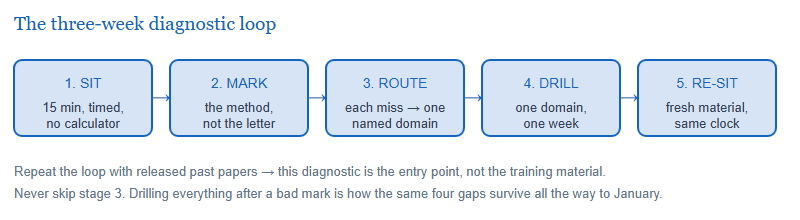
Sit the eight problems below in fifteen minutes, no calculator, then mark them against the worked key. The score itself is almost worthless — eight questions cannot predict an AMC 8 result. What is worth having is the routing table at the end, which converts each specific miss into one specific thing to study this week. Print the problems, cover the key, start a timer.
How to sit this diagnostic so the result means something
A diagnostic only works if the conditions are honest. The real paper is 25 questions in 40 minutes with no calculator — about 96 seconds a question. This set gives you 15 minutes for 8, roughly 112 seconds each, deliberately a little generous because you are sitting cold on unfamiliar material rather than warmed up mid-paper.
- 15 minutes, timed, one sitting. Stop when the timer stops, even mid-working. Where you ran out is data.
- No calculator. The AMC 8 is calculator-free, so a diagnostic sat with one tells you nothing about the exam you are entering.
- Blank scratch paper and a pencil. Keep the paper — you will need your working when you mark.
- Answer all eight. The AMC 8 awards one point per correct answer with no deduction for a wrong or blank response, so a considered guess is free. Mark a guess with a small dot so you can tell it apart from a solve when you mark.
- Do not read ahead. The answer key sits directly under the problems on this page. Scroll past it, or fold the printout.
These eight problems are our own, written in the style of the competition to probe eight different topic domains. They are not past AMC 8 questions and they are not endorsed by the MAA. When you want the real thing, work from released papers.
The eight problems
-
Percent. A jacket is priced at 400 yuan. It is reduced by 25%, and the reduced price is then reduced by a further 20%. What is the final price, in yuan?
(A) 220 (B) 230 (C) 240 (D) 260 (E) 300 -
Number theory. What is the units digit of 32026?
(A) 1 (B) 3 (C) 7 (D) 9 (E) 8 -
Counting. A café sells 4 kinds of tea and 3 kinds of pastry. A set meal is one tea and one pastry, except that jasmine tea may not be paired with the egg tart. How many different set meals are possible?
(A) 7 (B) 11 (C) 12 (D) 13 (E) 24 -
Geometry. In rectangle ABCD, AB = 12 and BC = 8. Point M is the midpoint of side AB. What is the area of triangle MCD?
(A) 24 (B) 32 (C) 48 (D) 64 (E) 96 -
Ratio. Three friends divide a bill in the ratio 2 : 3 : 5. The largest share is 42 yuan more than the smallest share. What is the total bill, in yuan?
(A) 84 (B) 100 (C) 126 (D) 140 (E) 210 -
Probability. A bag holds 3 red, 4 blue and 5 green marbles. Two marbles are drawn at random without replacement. What is the probability that both are green?
(A) 5/33 (B) 25/144 (C) 1/6 (D) 5/36 (E) 10/33 -
Statistics. The mean of five numbers is 18. One of the numbers is removed, and the mean of the four remaining numbers is 20. What number was removed?
(A) 2 (B) 10 (C) 12 (D) 18 (E) 38 -
Sequences. A sequence begins at 5. Each following term is obtained from the one before it by halving it if it is even, or adding 3 to it if it is odd. What is the 2026th term?
(A) 1 (B) 2 (C) 4 (D) 5 (E) 8
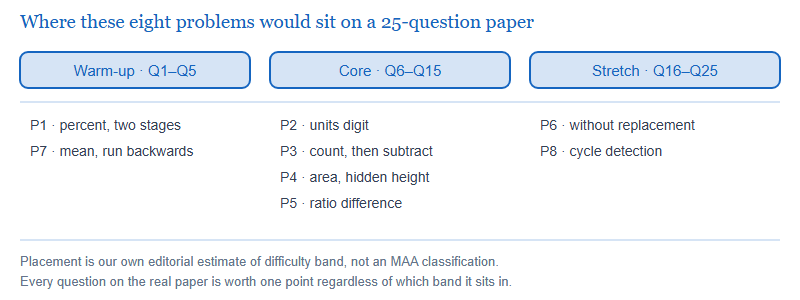
The worked answer key
Mark strictly. A right answer reached by a wrong method counts as a miss for routing purposes — the method is what carries over to the next paper. The column that matters most is the last one: if the trap listed there is what happened to you, you have found a repeatable leak rather than a one-off slip.
| # | Answer | The move that gets it | The trap that eats it |
|---|---|---|---|
| 1 | (C) 240 | Multiply the survivors: 400 × 0.75 = 300, then 300 × 0.80 = 240 | Adding the discounts to 45% and computing 220. Successive percents never add. |
| 2 | (D) 9 | Units digits of powers of 3 cycle 3, 9, 7, 1 with period 4. 2026 leaves remainder 2, so take the second entry. | Off-by-one in the cycle: reading remainder 2 as the third entry (7) instead of the second. |
| 3 | (B) 11 | Count everything, then remove the exception: 4 × 3 = 12, minus the one forbidden pair = 11 | Forgetting the exclusion (12), or adding 4 + 3 = 7 because “and” was read as a sum. |
| 4 | (C) 48 | Base CD = 12, height = 8 (the distance between AB and CD), so the area is ½ × 12 × 8 = 48 | Using the midpoint as if it halved the area again (24). The midpoint is irrelevant here. |
| 5 | (D) 140 | Let the parts be 2k, 3k, 5k. Then 5k − 2k = 3k = 42, so k = 14 and the total is 10k = 140. | Setting k = 42, or differencing the wrong two parts (5k − 3k). |
| 6 | (A) 5/33 | (5/12) × (4/11) = 20/132 = 5/33 | Treating the second draw as if the marble went back: (5/12)2 = 25/144. |
| 7 | (B) 10 | Work in totals, not means: 5 × 18 = 90 and 4 × 20 = 80, so the removed number is 10. | Subtracting the means (20 − 18 = 2). Means do not subtract like quantities. |
| 8 | (B) 2 | Generate until it repeats: 5, 8, 4, 2, 1, 4, 2, 1, … From the 3rd term on it cycles 4, 2, 1 with period 3. | Trying to compute forwards, or starting the cycle count at term 1 instead of term 3. |
Problem 6 in full. Without replacement means the bag changes between draws. There are 12 marbles and 5 are green, so the first draw is green with probability 5/12. Given that it was green, 11 marbles remain and 4 are green, so the second draw is green with probability 4/11. Multiply, because both must happen: 20/132, which cancels to 5/33. The distractor 25/144 is exactly what you get by forgetting that the bag changed — which is why the phrase “without replacement” is the single most important thing to underline in the stem.
Problem 8 in full. Nobody computes 2026 steps. Write terms until something repeats: 5, 8, 4, 2, 1, and then 1 is odd, so add 3 to get 4 — and you are back where you were at the third term. From term 3 onwards the sequence cycles 4, 2, 1 with period 3. Count positions from term 3: 2026 − 3 = 2023, and 2023 = 3 × 674 + 1, so term 2026 sits one step past the start of a cycle — the second entry, 2. Then check the method on a small case you can verify by hand: term 4 gives 4 − 3 = 1, remainder 1, second entry, 2; the written-out list says term 4 is 2. The method holds.
The routing table: turn each miss into one week’s work
This is the part to keep. Find every problem you missed, read across, and do only what the last column says. In our own coaching — our observation, not published data — students who miss four problems and respond by “doing more past papers” often miss the same four next time, while students who repair one named gap tend to see it less often. If you have not yet settled whether you are sitting the January paper at all, deal with that in parallel — our guide to the in-person January AMC 8 and how China-based families find a centre covers the logistics side.
| Missed | Domain | What the miss actually means | This week’s drill |
|---|---|---|---|
| P1 | Percent and proportion | You are treating percents as additive quantities rather than as multipliers | Twenty successive-change questions. Write the multiplier chain before touching any arithmetic. |
| P2 | Number theory | You can find a cycle but cannot index into it reliably | Units digits of 2, 3, 7, 8 and 9 to assorted powers. Write the cycle, number the positions 1 to 4, then divide. |
| P3 | Counting | You are not separating “count all” from “remove the forbidden” | Complementary counting drills: total minus bad, never counting the good cases directly. |
| P4 | Geometry | You are hunting for a height instead of reading it off the figure | Ten triangle-in-rectangle areas. Name the base and the height out loud before writing any numbers. |
| P5 | Ratio | You have no standard notation for ratio problems | Rewrite every ratio as parts times k, then translate the sentence into one equation in k. |
| P6 | Probability | You are not registering replacement language in the stem | Pairs of near-identical questions, one with replacement and one without, until the distinction is automatic. |
| P7 | Statistics | You are manipulating averages instead of totals | Mean-change problems only. First line of every solution: convert each mean into a sum. |
| P8 | Sequences and logic | You did not think to look for a cycle at all | Iterated-rule problems. Generate eight terms before attempting anything clever, and verify on a small case. |
What your eight-question score does and does not tell you
Read this narrowly. Eight questions are a routing instrument, not a predictor, and anyone converting a diagnostic score into a projected AMC 8 result is over-reading it. Official scoring, percentiles and recognition tiers come from the real paper and the MAA’s own reporting — confirm those on maa.org.
- 7–8 correct. Content is not your constraint. Your remaining gains sit in pace and in the stretch band, so move to full timed papers rather than more topic work.
- 5–6 correct. One or two domains are leaking. The routing table names them — repair those before your next full paper, or the paper simply re-measures the same holes.
- 3–4 correct. More than half the domains are unstable. Rebuild them one at a time on a schedule; mixed papers at this stage mostly generate discouragement.
- 0–2 correct. This is a sequencing signal, not a verdict, and it is common for students meeting contest mathematics for the first time. Work through the topic domains systematically before sitting anything timed again.
One thing this diagnostic deliberately does not measure is endurance. Eight problems in fifteen minutes is a sprint; the real paper asks for 25 in 40 minutes, with the hardest material arriving when you are most tired. That only comes from full-length sittings, which is why stage 5 of the loop moves to complete released papers. And keep the preparation plan and the entry plan on separate tracks — the January sitting and centre arrangements run to their own deadlines regardless of how your studying is going.
Frequently asked questions
Are these real AMC 8 problems?
No. They are original problems written by us in the style of the competition. For authentic material, work from the MAA’s released past papers.
Should I guess on problems I cannot finish?
Yes. The AMC 8 gives one point per correct answer with no deduction for wrong or blank, so a guess is free. Mark your guesses when you review.
My score was high but my methods were messy. Does that matter?
Yes. Mark the method, not the letter. A lucky answer on this set becomes a lost point on a harder version of the same idea.
How often should I re-run a diagnostic like this?
Roughly every three weeks, on fresh material each time. Re-sitting the same eight problems measures memory, not mathematics.
This is an independent guide operated by Hanlin Education for China-based international-school students. We are not affiliated with, endorsed by, or sponsored by the Mathematical Association of America (MAA). The practice problems above are our own and are not official AMC 8 material; competition format, scoring and rules change between cycles — confirm all current details on maa.org and with your test centre before acting. Any error brought to our attention is corrected within 7 working days.