Ratio, rate and percent questions reward one habit above all others: multiply, do not add, and find the value of one part before you find anything else. This page is a card to keep beside your practice — a multiplier lookup table, the six setups that cover almost the whole domain, ten original drills, and a key that shows the fastest route rather than just the answer.
The AMC 8 gives you 25 questions in 40 minutes with no calculator, sat in person during a January window (confirm the exact date on maa.org and with your test centre — the logistics of finding a centre are set out in our 2026-27 in-person AMC 8 guide). Forty minutes across 25 questions is an average of 96 seconds each. That budget is the whole reason this domain matters: percent and ratio items are among the fastest marks on the paper if you use the right move, and among the slowest if you set up an equation you did not need.
1. The multiplier card
Almost every percent question on a middle-school paper reduces to multiplying by a number. Learn the multiplier, not the formula. To increase by p%, multiply by 1 + p/100. To decrease by p%, multiply by 1 − p/100. To undo either one, divide by the same multiplier — never multiply by it again with the sign flipped.
| Change | Multiplier | To undo it | Applied to 240 |
|---|---|---|---|
| up 5% | × 1.05 | ÷ 1.05 | 252 |
| up 10% | × 1.10 | ÷ 1.10 | 264 |
| up 20% | × 1.20 | ÷ 1.20 | 288 |
| up 25% | × 1.25 | ÷ 1.25 | 300 |
| up 50% | × 1.50 | ÷ 1.50 | 360 |
| down 10% | × 0.90 | ÷ 0.90 | 216 |
| down 20% | × 0.80 | ÷ 0.80 | 192 |
| down 25% | × 0.75 | ÷ 0.75 | 180 |
| down 40% | × 0.60 | ÷ 0.60 | 144 |
| down 50% | × 0.50 | ÷ 0.50 | 120 |
Two families of conversions are worth having in memory rather than deriving under time pressure: 1/8 = 12.5%, 1/6 ≈ 16.7%, 1/3 ≈ 33.3%, 3/8 = 37.5%, 5/8 = 62.5%, 5/6 ≈ 83.3%. In our own marking, the sixths and eighths are the two families that most often appear as an answer choice in a form students do not recognise.
2. Six setups that cover the domain
MAA describes the AMC 8 as drawing on the middle-school curriculum; the current content description lives on maa.org. Within that, ratio and percent work keeps reappearing in six shapes. Learn to name the shape from the wording before you write anything down.
| # | Setup | Signal in the wording | First move | Where marks leak |
|---|---|---|---|---|
| 1 | Part–whole percent | “what percent of”, “% of the students” | Write part over whole, then × 100 | Using the wrong whole (the group after a change, not before) |
| 2 | Percent change | “increased by”, “reduced by”, “discount” | Multiply by 1 ± p/100 | Adding the percentages together instead of multiplying |
| 3 | Reverse percent | “after a 25% rise the price is …” | Divide by the multiplier | Taking the percentage off the new number instead of dividing |
| 4 | Ratio to quantity | “in the ratio 5 : 3”, “for every 4 …” | Draw parts, find the value of one part | Using the total when the clue was a difference (or the reverse) |
| 5 | Unit rate | “per”, “every 4 seconds”, “at this rate” | Scale by a whole-number factor if one exists; otherwise find the rate for one unit | Dividing to a messy decimal when a clean factor was available |
| 6 | Weighted mean / mixture | Two groups of different sizes, each with its own average | Multiply each mean by its count, add, divide by the total count | Averaging the two averages |
3. Why an equation is often the slow route
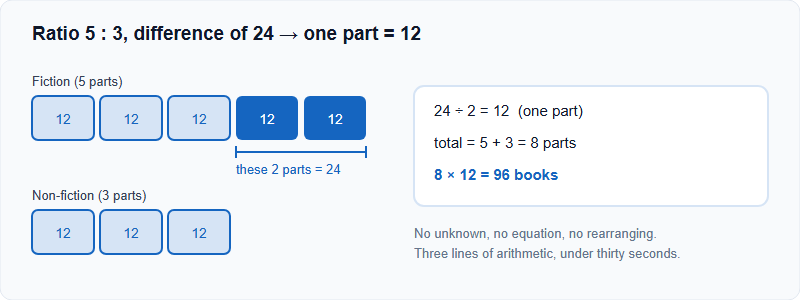
Setup 4 is the one where written algebra costs the most. A ratio statement already tells you the shape of the answer; all that is missing is the size of one part. Draw the parts, find what one part is worth, then take as many parts as the question asks for. The diagram below is the whole method on one question type.
4. Four traps that cost marks
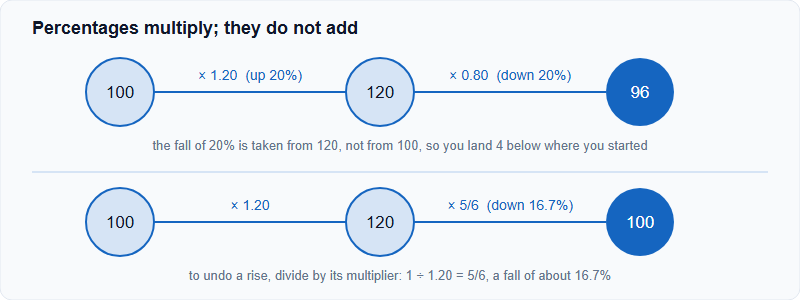
- Percentages do not add. Up 20% then down 20% does not return you to the start, because the fall is taken from the larger number. The chain below shows exactly where the missing 4% goes.
- The base can move mid-question. “30% of the boys” and “30% of the students” are different quantities. Before you compute a percentage, underline the noun that follows “of”.
- “20% more than” is not “20% of”. The first means × 1.2; the second means × 0.2. Reading speed causes more errors here than arithmetic ever does.
- Averaging averages. If a class of 18 averages 80 and a class of 12 averages 90, the combined average is not 85. Weight each mean by its count first.
5. Ten drills
These are original problems written for this card, not past-paper questions. Work them on paper with no calculator and give yourself sixteen minutes for all ten — that is the same 96 seconds per question the real paper allows. Write down the setup number from the table above before you calculate.
- A reading list holds fiction and non-fiction in the ratio 5 : 3. There are 24 more fiction books than non-fiction. How many books are on the list?
- A jacket costs 250 yuan. It is reduced by 20%, and the reduced price is then reduced by a further 15%. What is the final price?
- A number is increased by 25% and the result is 60. What was the number?
- Class A has 18 students averaging 80 marks; Class B has 12 students averaging 90. What is the mean for all 30 students?
- A printer produces 7 pages every 4 seconds. How many seconds does it take to print 91 pages?
- A bag holds red and blue counters in the ratio 3 : 4. After 6 more red counters are added, the ratio becomes 9 : 8. How many counters are in the bag now?
- A map is drawn to a scale of 1 cm to 25 km. Two towns are 14.4 cm apart on the map. How far apart are they in reality?
- Girls make up 40% of a club. After 12 more girls join and nobody leaves, girls make up 50%. How many members were there originally?
- A recipe for 6 people uses 450 g of rice. How much rice is needed for 15 people?
- A price rises by 20%. By what percent must the new price now fall so that it returns to the original price?
6. Worked key
| # | Answer | The move that gets there in under a minute | The slip we see most |
|---|---|---|---|
| 1 | 96 books | Difference is 5 − 3 = 2 parts, so one part = 24 ÷ 2 = 12; total is 8 parts = 96. | Treating 24 as the total rather than the difference. |
| 2 | 170 yuan | 250 × 0.80 = 200, then 200 × 0.85 = 170. | Combining into a single 35% discount, which gives 162.50. |
| 3 | 48 | Reverse percent: 60 ÷ 1.25 = 48. | Taking 25% off 60 to get 45. |
| 4 | 84 | (18 × 80 + 12 × 90) ÷ 30 = 2520 ÷ 30 = 84. | Averaging 80 and 90 to get 85. |
| 5 | 52 seconds | 91 ÷ 7 = 13 batches; 13 × 4 = 52. No decimal rate needed. | Computing 1.75 pages per second and then dividing. |
| 6 | 34 counters | Let the parts be 3k and 4k. (3k + 6) : 4k = 9 : 8 gives 24k + 48 = 36k, so k = 4. Now 18 red and 16 blue. | Adding 6 to both sides of the ratio as if it were a total. |
| 7 | 360 km | 14.4 × 25 = 360. | Dividing by the scale instead of multiplying. |
| 8 | 60 members | 0.4n + 12 = 0.5(n + 12) gives 0.1n = 6, so n = 60. Check: 24 girls becomes 36 of 72. | Forgetting that the total also grows by 12. |
| 9 | 1125 g | 450 ÷ 6 = 75 g per person; 75 × 15 = 1125. | Scaling by 2.5 but applying it to the number of people instead. |
| 10 | about 16.7% (exactly 16 2/3%) | Undo × 1.2 by dividing: 1 ÷ 1.2 = 5/6, a fall of 1/6. | Answering 20% by symmetry. |
Two follow-ups worth doing this week. First, take any past paper you have already marked and re-tag every ratio, rate or percent item with one of the six setup numbers; the pattern of which setup you keep losing is more useful than a raw score. Second, put a date on the calendar for the January sitting itself — registration in China runs through authorized centres rather than individual sign-up, and the practical steps are in our in-person AMC 8 guide for 2026-27. Confirm the current window, rules and content description on maa.org before you plan around any date.
Frequently asked questions
Do I need to memorise percentage formulas for the AMC 8?
No. One idea covers the domain: to increase by p%, multiply by 1 + p/100. Learn the moves, not the formulas.
Is a bar model really faster than algebra on ratio questions?
Usually yes. With 40 minutes for 25 questions, scaling parts beats setting up and rearranging an equation you did not need.
Why is up 20% then down 20% not back where you started?
Because the fall is taken from the larger number. 100 becomes 120, and 120 × 0.8 = 96, so you finish 4 below.
Where do I check the AMC 8 date and rules?
On maa.org for the official window, content and rules, and with your authorized test centre for the local sitting date and registration.
This is an independent guide operated by Hanlin Education for China-based international-school students. We are not affiliated with, endorsed by, or sponsored by the Mathematical Association of America (MAA). Competition rules, dates, content descriptions and fees change: confirm current details on maa.org and with your authorized test centre before acting on anything here. Any error reported to us is corrected within 7 working days.