A school club is not a study plan with more people in the room. It has one leader, sixty minutes, mixed grades, and students who will miss two sessions out of ten. This planner is built for those constraints: a backwards calendar of the admin the leader owns, ten sessions with the artefact each one must produce, a minute-by-minute run sheet, and a tracking grid.
Why a club plan is not a study plan
Individual preparation can be sequenced perfectly, because one student either does the work or does not. A club cannot. Attendance is uneven, the ability spread inside one room can be three years wide, and the leader is often a teacher with a full timetable or a Grade 8 student running it at lunchtime. A plan that assumes continuity will collapse by session four.
So the design rule is: every session must produce one artefact that survives without you. A card, a marked paper, a short list. A student who misses session five should be able to pick up the artefact and rejoin at session six without a private catch-up. That single constraint is what separates clubs that finish the season from clubs that quietly stop in November.
The second design rule is that a club is worth attending only for what solo study cannot give: a genuinely timed room, other people’s wrong answers, and someone who owns the admin. Anything a student could do better alone at a desk should be homework, not session time.
The backwards calendar: what the leader owns
Two facts sit side by side here, and neither corrects the other. The MAA publishes the competition window and posts it on maa.org. Individual centres then schedule their own sitting inside that window. Per China test-centre information for the coming season, the sitting is 22 January 2027, with centre registration closing 12 January 2027 at RMB 120 per entry, and papers supplied in Chinese and English. Confirm the window on maa.org and the day, the price and the closing date with your own centre before you publish any date to families.
Entry runs through one of three routes, per the same centre information: a partner school registering its students centrally; the ASDAN mini-programme, where the school is an ASDAN partner; or an agency registering an independent candidate. Agency deadlines are typically earlier than the official closing date. The practical consequence for a club leader is a single rule: work to the earliest deadline in your chain, not the published one. If your entries pass through an agency, that agency’s cut-off is your real deadline, and you should have it in writing before session one. Our guide to the in-person January AMC 8 for China-based families sets out how the routes differ and what each asks of the family.
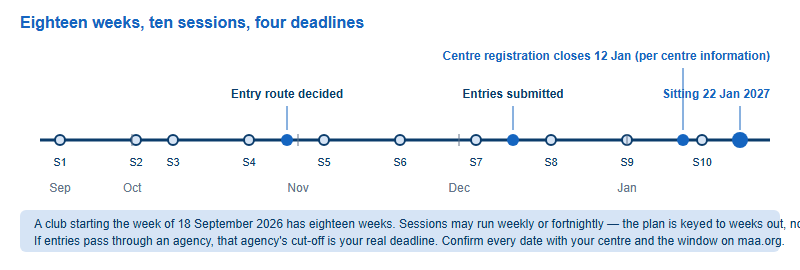
The ten sessions
Keyed to weeks before the sitting, so it works whether you meet weekly for one term or fortnightly across two. The artefact column is the part not to negotiate away.
| Session | Weeks out | Focus | Artefact produced | Between sessions |
|---|---|---|---|---|
| S1 | 18 | Baseline. A full timed paper under real conditions, marked in the room | Baseline score sheet: score out of 25, and which of the four question blocks lost the marks | Nothing. Let the baseline sit |
| S2 | 16 | Reading the question: quantifiers, units, and what the answer is actually asking for | Quantifier card — the six words that change a problem | Ten stems, quantifier boxed, unsolved |
| S3 | 15 | Arithmetic without a calculator: fractions, percentages as multipliers, estimation | Multiplier card | One twelve-question timed set |
| S4 | 13 | Counting and probability: the small number of setups that cover most questions | Setup card, with a worked example each | Eight counting questions |
| S5 | 11 | Geometry: the configurations that recur, and marking given properties on a figure | Configuration sheet | Eight geometry questions |
| S6 | 9 | Number theory: divisibility, units digits, remainders | Divisibility card | Eight number questions |
| S7 | 7 | Data and averages: reading charts label-first, and the mean-total identity | Data lookup card | One twelve-question timed set |
| S8 | 5 | Full timed mock under exam conditions: in person, on paper, no calculator, 40 minutes | Marked paper plus a personal error log, sorted into reading / method / arithmetic | Redo only the questions in your own top error category |
| S9 | 3 | Error clinic. Reteach only what the club’s own logs show, not what you planned to teach | The club’s top-five error list, written on one page | One timed set built from that list |
| S10 | 1 | Second timed mock, then the logistics briefing: what to bring, what time to arrive, what the day looks like | Exam-day run sheet, one per student | Rest. No new material in the final week |
Two notes on sequencing. The baseline goes first, before any teaching, because a club that teaches for six weeks and then discovers its members lose marks on reading rather than on topics has spent six weeks on the wrong thing. And the second mock sits at one week out rather than in the final days, so that there is time to act on it without cramming into the last evening.
The sixty-minute run sheet, and what to cut
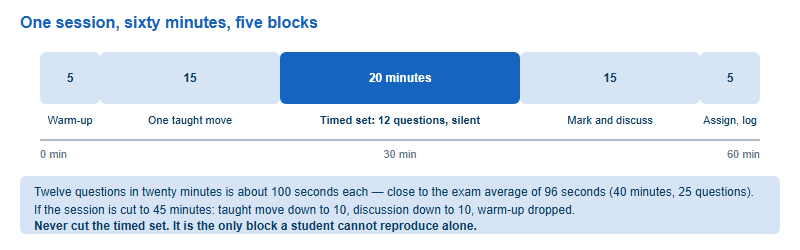
Discussion is the block leaders overrun, so give it a rule rather than a feeling: discuss only questions that more than a third of the room got wrong. Everything else goes on the artefact or into homework. A question two students missed is a conversation for those two students, not fifteen minutes of the club’s only weekly hour.
Five ways clubs lose their sessions, in the order we see them most often:
- Solving from the front. The leader works a hard problem beautifully on the board while nobody holds a pen. Students remember that they understood it and cannot reproduce it a week later.
- Starting with the hardest questions because they are more interesting to teach. The later questions on the paper are worth exactly one mark each, the same as the early ones.
- No artefact. A brilliant session that leaves nothing on paper does not survive an absence.
- Untimed practice all term, then a first timed paper in January. Timing is a separate skill and it has to be trained early.
- Admin left to the last fortnight, when the earliest deadline in the chain may already have passed.
Three lanes in one room, and the tracking grid
Most clubs contain three populations at once. Run one plan and three targets rather than three plans.
| Lane | Who | What success looks like this season | Adjustment to the plan |
|---|---|---|---|
| Lane A | First-timers, younger students | Finishing a full timed paper without panic, and a baseline to build on next year | Timed set of 8 rather than 12; homework halved |
| Lane B | Second-year students | Converting the early and middle blocks reliably; fewer reading losses | Full plan as written |
| Lane C | Grade 8 students in their final eligible year | Attacking the later blocks, having secured everything before them | Extra four-question challenge set as homework, never in session time |
On targets, be careful about what you promise a room of students. Per the same China centre briefing, the recognition structure includes a perfect-score award; a global Distinguished Honor Roll at roughly the top 1%, which in practice has meant somewhere around 21 correct; an Honor Roll at roughly the top 5%, around 17 correct; and an achievement award for students in grade 6 and below scoring 15 or more. Treat those correct-answer figures as typical rather than fixed thresholds — percentile-based awards move with the cohort each year, and the definitive award structure is the MAA’s, so confirm it on maa.org.
Used properly, that structure is a planning tool rather than a promise. It gives a Grade 6 club member a concrete personal target that does not depend on beating older students, which is exactly what younger lanes need. Set targets against a student’s own baseline from session one, and never present any score as producing a particular outcome — competitions are one signal among many, and results vary.
Track the club on five columns and nothing more: date, attendance, artefact produced, timed-set score, and the single dominant error category for the session. Five columns fit on one page for a whole term, and the pattern you are looking for is visible by session five — whether your club loses marks to reading, to method, or to arithmetic. Those three have different fixes, and choosing between them by instinct is how a term gets spent on the wrong one. For the exam-day briefing in session ten, work from what your centre tells you and from our in-person January guide, and confirm anything about materials or timing with the centre directly.
Frequently asked questions
Can this run fortnightly instead of weekly?
Yes. The plan is keyed to weeks before the sitting, not to dates. Fortnightly needs about twenty weeks, so start in early September.
What if students join after session three?
Give them the artefacts from the sessions they missed and start them on the current homework. That is what the artefacts are for.
How many full mocks should a club run?
Two in session, at five weeks and one week out, plus the baseline. More than that eats the teaching time that makes mocks useful.
Who handles registration for a school club?
It depends on your route — central school entry, ASDAN mini-programme, or an agency. Confirm the closing date with your centre; agency deadlines are typically earlier.
This is an independent guide operated by Hanlin Education for China-based international-school students. We are not affiliated with, endorsed by, or sponsored by the Mathematical Association of America (MAA). Competition dates, eligibility, formats and awards are set by the MAA — confirm current details on maa.org, and confirm sitting arrangements, fees and deadlines with your test centre. Errors reported to us are corrected within 7 working days.