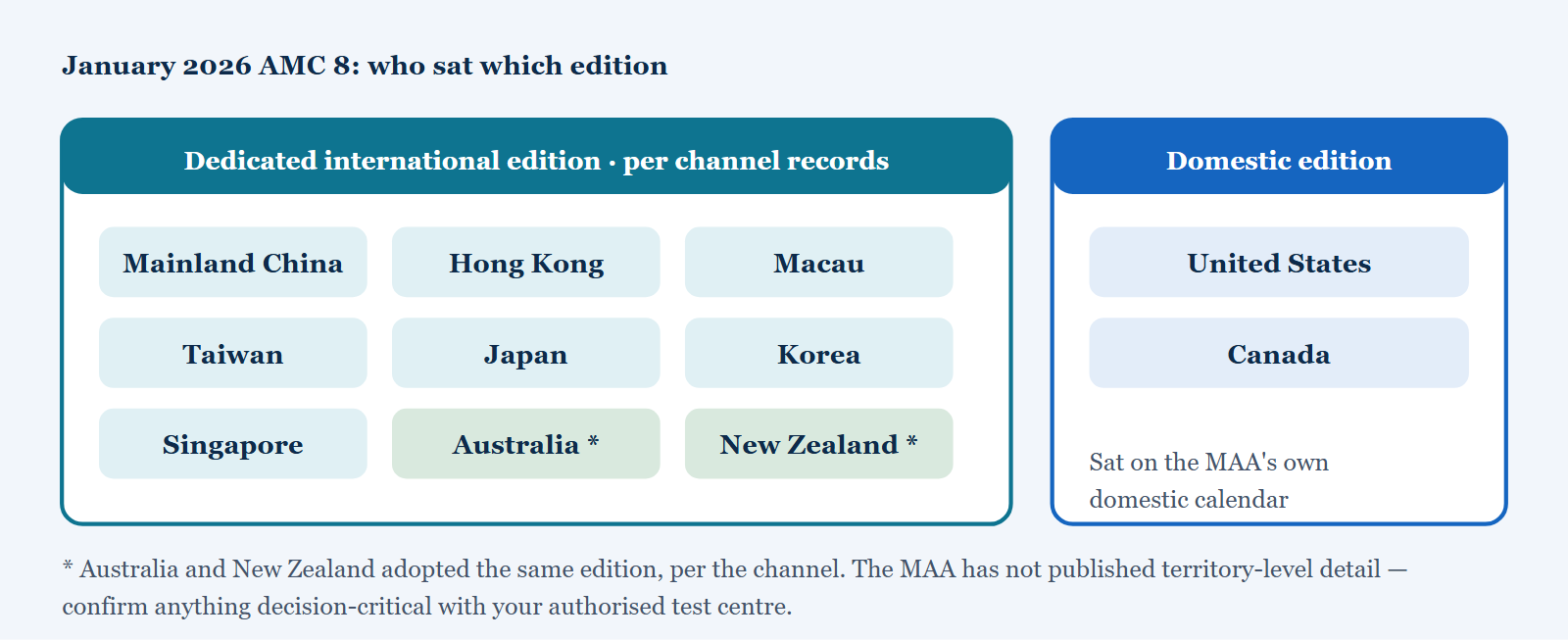
Here is a detail most families sitting the AMC 8 from China never hear: the paper may not be the same physical edition American students sit. According to the China organising channel’s records, the January 2026 AMC 8 was administered across China, Hong Kong, Macau, Taiwan, Japan, Korea and Singapore using a dedicated international edition supplied by the MAA, with Australia and New Zealand adopting the same edition. The MAA has not published this arrangement in detail, so treat it as channel-level information — but it fits everything else we can observe about how the China sitting runs, and it has practical consequences worth understanding before the next window.
What the channel’s records say — and how much weight to put on them
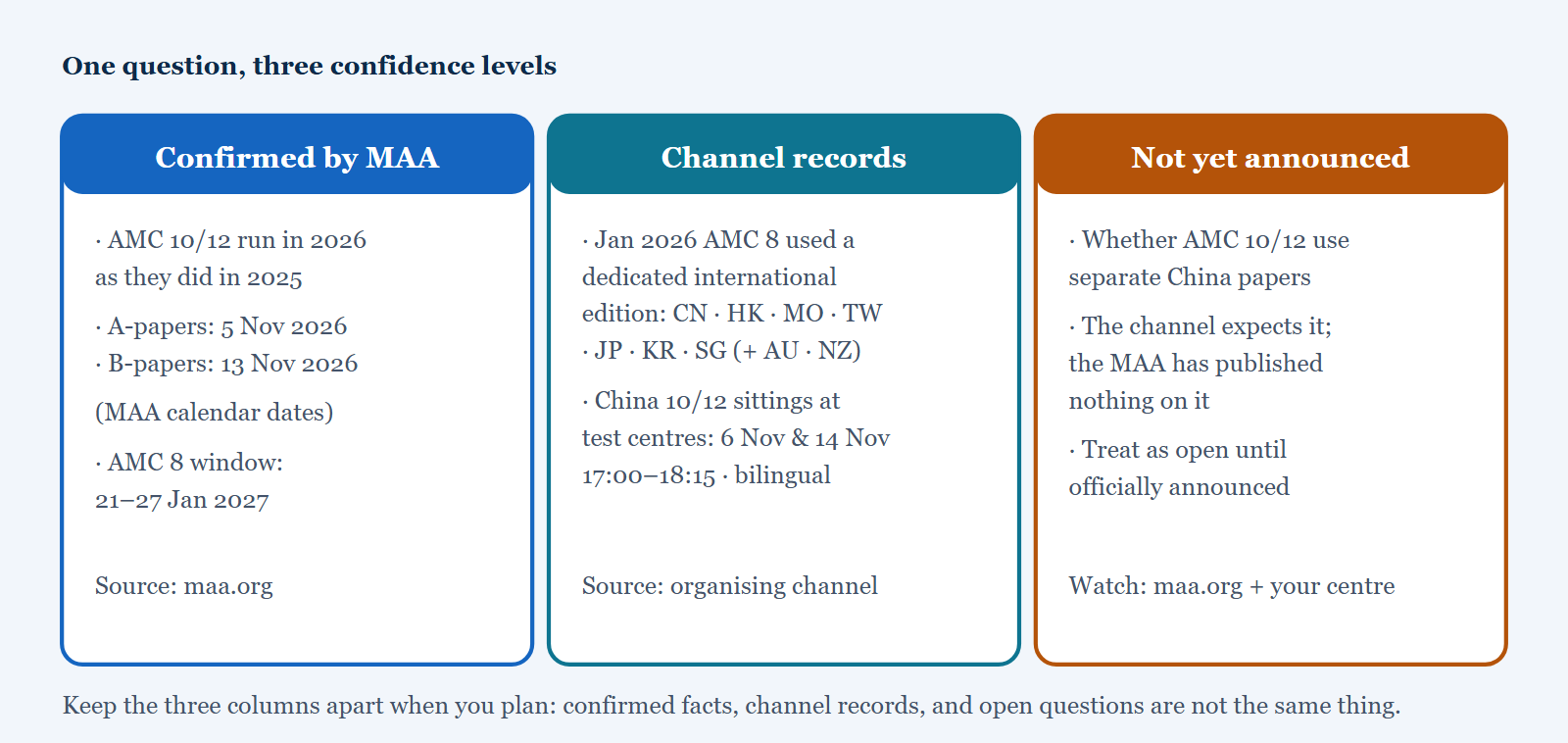
Three claims are in circulation, and they deserve three different levels of confidence. First, the record of what already happened: the January 2026 AMC 8 used a special edition across the territories listed above. That is a statement about a past administration from the channel that helped run it — solid enough to plan around, though the MAA itself has not published territory-level detail, so confirm anything decision-critical with your test centre. Second, an inference about what comes next: the channel reads this as making dedicated China-region papers for AMC 10/12 likely. That is their inference, clearly labelled as such — the MAA has not announced China-region arrangements for the November 2026 sittings, and the channel’s own notice says so. Third, what the MAA has actually confirmed publicly: the AMC 10 and AMC 12 will be administered in 2026 as they were in 2025, with A-papers on 5 November and B-papers on 13 November on the MAA’s own calendar.
Why a separate edition is less surprising than it sounds
If you have sat the AMC 8 at a China test centre, you have already seen evidence of a distinct administration: the paper is bilingual, with an English column and a Chinese column and a set of layout conventions worth knowing in advance — we documented them in the bilingual paper protocol. A bilingual paper is, by definition, not the identical booklet used in an Ohio classroom. Time zones supply the structural reason: an exam sat across a week-long international window, hours or days apart from the US sitting, needs integrity protection, and distinct editions are the standard tool for that. The same logic already shows up in the sitting dates themselves — the MAA’s November dates and the China test-centre dates (6 and 14 November per the channel) are different days, and neither corrects the other.
What it changes for you: almost nothing — with two exceptions
The syllabus, format and scoring do not move: 25 questions, 40 minutes, no calculator, whichever edition lands on your desk. Your preparation is edition-independent, which is why our advice remains what it was in the trigger index and the self-diagnostic: train the moves, not the specific paper. The two genuine exceptions:
1 · Cross-region score talk needs a caveat. If editions differ, then comparing a China-sitting score with a US-sitting score is comparing performances on different question sets. The MAA publishes achievement levels — Honor Roll and Distinguished Honor Roll are defined on the distribution — so treat headline comparisons between regions with more caution than a single-number conversation implies. How the MAA handles cutoffs across editions is not something the channel’s records settle; that lands in the “open” column.
2 · Your registration route decides your edition, your date and your paperwork. China-based candidates sit through authorised test centres, and everything downstream — sitting date, edition, bilingual format, reporting — follows from that entry. If you have not locked your entry details yet, work through the registration data sheet and the registration channel page early rather than in January.
The bigger 2026–27 picture this slots into
This edition question is one piece of a season with real structural change elsewhere: from 2027 the AIME moves to fixed qualifying scores (100+ on AMC 10, 85+ on AMC 12), two electronically delivered 90-minute parts, and a single February window — changes the MAA has published and that we covered in detail on our sister site’s AIME guide. Against that backdrop, “which edition of the AMC 8 you sit” is the calmest item on the list: it changes logistics and comparability footnotes, not what you study. Keep your eye on the two things that are actually yours to control — entry secured through your centre, and a preparation plan that survives any edition. For exam-day rules under a China administration, our rules audit covers what you may bring and who may proctor.
Frequently asked questions
Is the AMC 8 paper in China different from the US paper?
According to the China organising channel’s records, the January 2026 AMC 8 used a dedicated international edition across China, Hong Kong, Macau, Taiwan, Japan, Korea and Singapore, with Australia and New Zealand adopting it as well. The MAA has not published territory-level detail on this, so confirm specifics with your test centre. Format, syllabus and scoring are the same either way.
Will AMC 10 and AMC 12 also use separate China papers in November 2026?
Unannounced. The organising channel reads separate China-region papers as likely given the AMC 8 precedent, but that is their inference — the MAA has not published China-region arrangements for the November sittings. What the MAA has confirmed is that AMC 10/12 run in 2026 as they did in 2025, with A-papers on 5 November and B-papers on 13 November on its own calendar; China test-centre sitting dates are set separately by the centres.
Does a different edition change how I should prepare?
No. The syllabus, the 25-question 40-minute format and the scoring are constant across editions, so preparation is edition-independent. The only practical adjustments are knowing the bilingual paper conventions used at China centres and being cautious when comparing scores across regions, since different editions mean different question sets.
When is the next AMC 8?
The MAA lists the next AMC 8 window as 21 to 27 January 2027. Centres choose their sitting day inside the window, so your exact date comes from your own test centre — do not copy last year’s date or another school’s.
MAA-published facts are as listed at maa.org (checked recently); international-edition and China test-centre details are per the organising channel’s records and should be confirmed with your authorised test centre. This site provides registration and preparation support for China-based candidates and is not the MAA. Corrections within 7 working days of notice.