Why Consecutive Integer Problems Trip Up Students
Consecutive integers are a staple of the AMC 8 number theory and algebra sections. While the concept seems simple—numbers that follow each other in order without gaps—students often lose points due to setup errors or failing to check constraints. The key to solving these efficiently is understanding the relationship between the sum, the count, and the average (mean) of the sequence.
Translating “Consecutive” vs. “Consecutive Odd/Even”
The first step is precise translation from words to mathematical expressions. A common mistake is assuming all sequences increase by 1.
- Consecutive Integers: If the smallest number is , the sequence is . The difference between terms is always 1.
- Consecutive Even Integers: If the smallest number is (where is even), the sequence is . The difference is 2.
- Consecutive Odd Integers: If the smallest number is (where is odd), the sequence is . The difference is also 2.
Notice that for both even and odd sequences, the gap is 2. This impacts how you calculate the average and the total sum. Always define your variables clearly based on the specific type requested.
The Power of the Middle Number (Arithmetic Progressions)
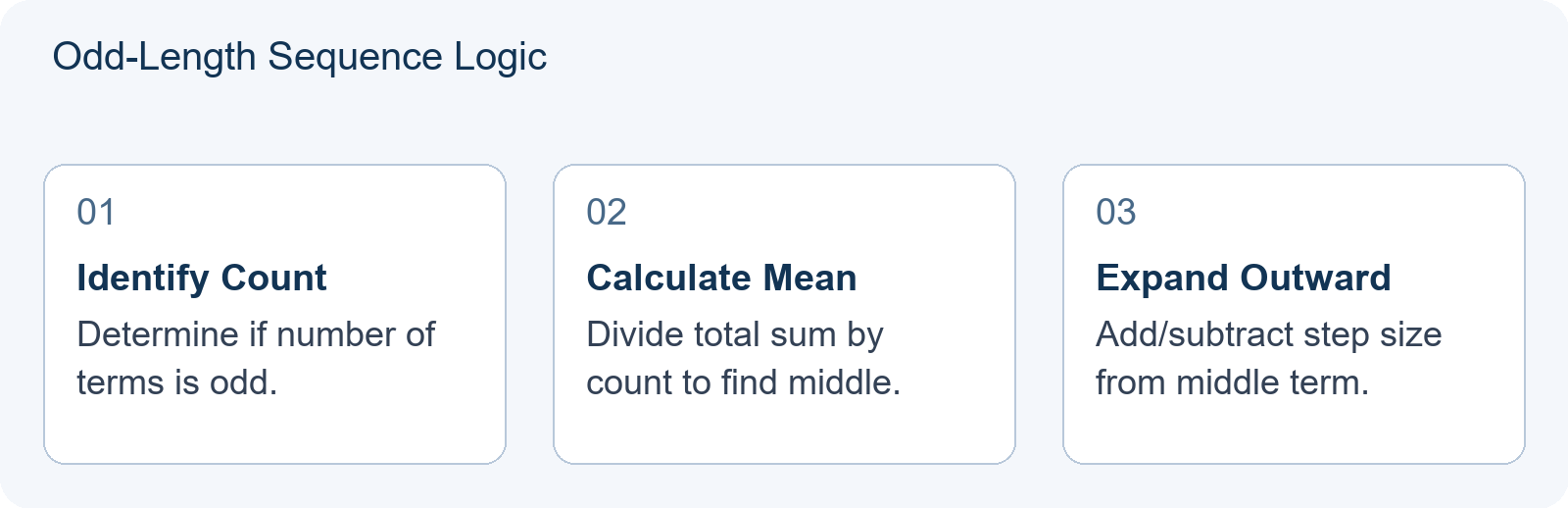
For any arithmetic sequence—where terms are equally spaced—the average equals the median. When the number of terms is odd, this median is an actual term in the sequence, giving a rapid mental shortcut.
Teaching Illustration: Consider five consecutive integers whose sum is 50. Since there are 5 terms (an odd number), the average is . Because the sequence has equal spacing (step 1), the average equals the median, which is the middle term. Therefore, the middle term is 10. The sequence must be symmetric around 10: . No complex algebra is needed if you recognize this pattern.
This shortcut works because the deviations from the mean cancel out perfectly (). In AMC 8 multiple-choice contexts, spotting the middle number can save valuable seconds. The critical insight is that equal spacing (arithmetic progression), not merely odd count, makes the average equal to the median.
Handling Even-Length Blocks and Half-Integer Means
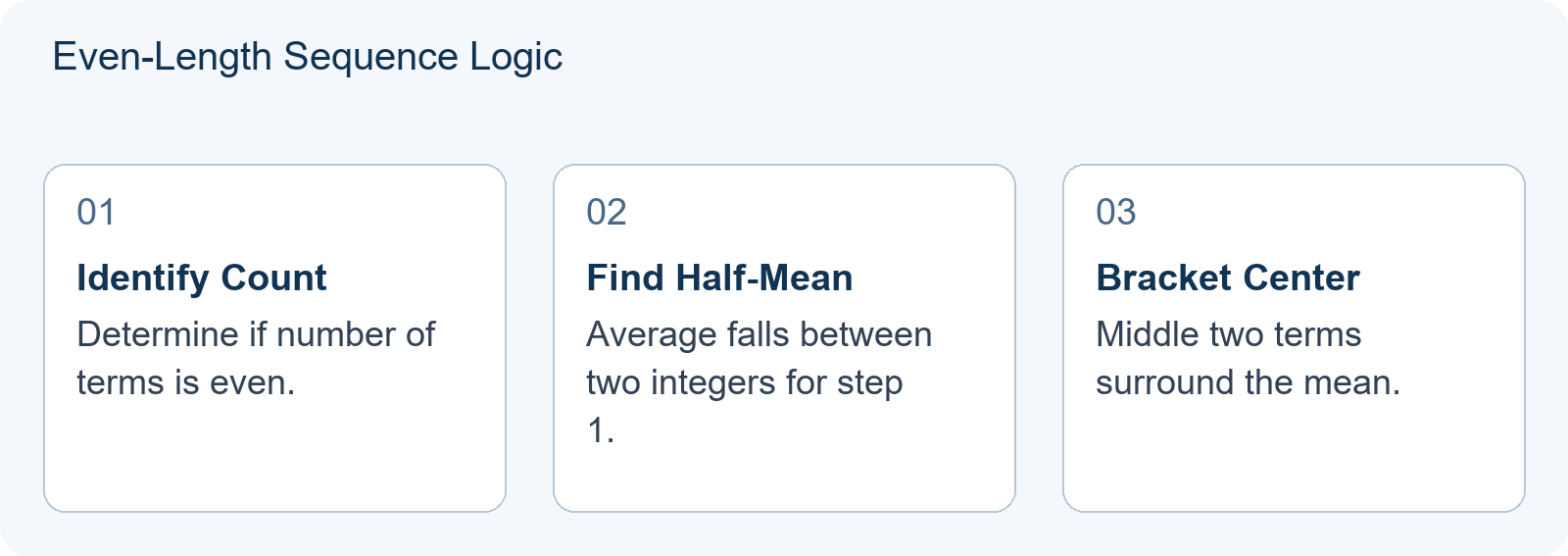
When the number of terms is even and the step size is 1, the average falls between two integers. It will be a half-integer (e.g., 10.5). This is a critical distinction because students sometimes incorrectly assume the average must be one of the numbers in the set.
Teaching Illustration: Four consecutive integers have a sum of 42. The average is . The two middle numbers must be 10 and 11. The full sequence is . Check: . Correct.
However, this half-integer phenomenon is specific to step-1 sequences. For even-length sequences with step 2 (consecutive odd or even integers), the average can be an integer. Consider four consecutive even integers: . Their sum is 44, and their average is —an integer, not a half-integer. The average 11 is not in the set, but it is an integer because the step size of 2 creates a different arithmetic structure.
Similarly, if a problem states that the average of four consecutive integers (step 1) is an integer, it is immediately impossible. You can use this logic to eliminate answer choices quickly.
Reverse Existence and Parity Cases
Checking whether a solution exists at all is as important as finding it. Three common reverse cases appear on the AMC 8:
Case 1: Integer average with even count and step 2. As shown above, four consecutive even integers can have integer average 11. The sequence demonstrates this. The average being integer does not create a contradiction here because the step is 2, not 1.
Case 2: Half-integer average with even count and step 1. If four consecutive integers had average 10 (an integer), no such sequence could exist. The middle two terms would need to surround 10 symmetrically, but with step 1, they would be 9 and 10 or 10 and 11—nething yields two integers centered on 10 with equal spacing of 1 on both sides. Specifically, if the average is 10, the sum would be 40, requiring , so , giving —not an integer. Thus no such sequence of four consecutive integers exists with average exactly 10.
Case 3: Odd count with wrong parity. Suppose a problem asks for three consecutive even integers with sum 57. The average is . Since the count is odd, the average equals the middle term, so the middle term would be 19. But 19 is odd, contradicting the requirement that all terms be even. No solution exists. This parity check is essential: when the count is odd and the average has the wrong parity for the requested sequence type, reject immediately.
Checking Integer and Positivity Constraints
Algebraic solutions often yield fractional results that must be rejected. For example, if you solve for in a sequence of three consecutive even integers and get , the solution is invalid because 7 is not even. Similarly, if the problem specifies “positive integers,” any negative or zero result must be discarded.
Always plug your final numbers back into the original conditions:
- Are they consecutive? (Check the difference).
- Do they meet the parity requirement? (All even or all odd).
- Do they satisfy the sum/product condition?
- Are they within the specified range (e.g., positive)?
Original Practice Questions
Apply the strategies above to these hypothetical diagnostic questions modeled after AMC 8 difficulty levels.
Question 1: The sum of three consecutive odd integers is 63. What is the largest of these integers?
Solution: There are 3 terms (odd count). Average = . The middle term is 21. Since they are consecutive odd integers, the sequence is . The largest is 23. Verification: , all odd, step 2 confirmed.
Question 2: Five consecutive even integers have a median of 14. What is their sum?
Solution: For an odd number of terms in an arithmetic sequence, the median equals the mean. Mean = 14. Sum = Mean Count = . The integers are . Check: All even, consecutive with step 2, median 14. Sum is 70.
Question 3: The product of two consecutive positive integers is 156. What is the smaller integer?
Solution: Let the integers be and . Equation: . Approximate . Try 12: . Yes. The smaller integer is 12. Verification: , both positive, consecutive with step 1.
Choosing Your Strategy Based on Error Type
If you consistently miss these questions, diagnose your error pattern:
- Setup Errors: If you write for consecutive evens, focus on variable definition drills.
- Calculation Errors: If you struggle with sums, practice the average method (Sum = Average Count).
- Constraint Oversight: If you select non-integer answers, build a habit of checking parity and positivity before marking your choice.
Next Steps: From Technique to Timed Performance
Mastering the average-to-middle-term shortcut is one component of broader number theory fluency. Students ready to benchmark their progress can review What Is a Good AMC 8 Score? Percentiles, Honor Roll, and How Results Are Read for percentile and honor-roll context. Those refining their score interpretation and next-step decisions may find additional value in AMC 8 Score: Converting Raw Results Into a Next-Step Decision Framework. For structured practice, the Your 2027 AMC 8 Date Is a Window, Not a Day: How to Plan a Peak You Can Move Six Days offers scheduling guidance that helps students allocate preparation time effectively.
Consecutive Integers in Geometry and Number Theory
The average-to-median shortcut is powerful, but AMC 8 problems often embed consecutive integers within geometric constraints or divisibility rules. Students frequently solve the algebraic sequence correctly but fail to apply the result to the broader context. This section addresses two common hybrid applications: perimeter calculations with integer side lengths and divisibility checks for sequences.
Perimeter Constraints with Integer Sides
A frequent problem type asks for the number of distinct triangles with integer side lengths that are consecutive and have a specific perimeter. Let the sides be . The triangle inequality requires that the sum of any two sides exceeds the third. The critical constraint is , which simplifies to , or . Thus, the smallest valid integer side is 2, yielding the sequence .
Teaching Illustration: How many distinct triangles with consecutive integer sides have a perimeter less than 20? The perimeter . We require , so , meaning . Since , possible values for are 2, 3, 4, and 5. These correspond to sequences , , , and . There are exactly four such triangles. Note that if the problem specified “right-angled,” only would qualify, demonstrating how additional geometric properties narrow the solution set derived from the consecutive integer base.
Divisibility of Consecutive Sums
Another application involves determining whether the sum of consecutive integers is divisible by . For an arithmetic sequence, Sum . If is odd, the average is an integer term in the sequence, so the sum is always divisible by . If is even, the average is a half-integer (e.g., ), so the sum is . This is divisible by only if is a multiple of , which is impossible for positive . Therefore, the sum of an even number of consecutive integers is never divisible by that count.
Teaching Illustration: Is the sum of six consecutive integers divisible by 6? No. Let the integers be . The sum is . Dividing by 6 gives . Since the result is not an integer, the sum is not divisible by 6. Conversely, the sum of five consecutive integers is , which is clearly divisible by 5. This rule allows students to eliminate answer choices instantly without calculating specific sums.
Integrating Constraints
When combining these ideas, always verify the domain. For example, if a problem states “positive consecutive integers,” ensure . If it specifies “distinct,” consecutive integers are inherently distinct, but this check prevents errors when modifying step sizes. In geometry contexts, remember that side lengths must be positive, adding another layer to the parity and integer checks already established.
Frequently Asked Questions
Can the average of consecutive integers be a decimal?
For consecutive integers with step 1, yes, but only when there is an even number of terms. The average will be a half-integer (ending in .5). However, for consecutive even or odd integers (step 2), an even count can produce an integer average. If the number of terms is odd, the average must be an integer equal to the middle term.
How do I represent consecutive even integers algebraically?
If the first even integer is x, the next is x+2, then x+4. Do not use x+1, as that would create an odd integer. Ensure x itself is defined as an even number. For three consecutive even integers, use x, x+2, x+4.
What if my algebraic solution gives a fraction?
This usually indicates an error in setting up the equation or that no such integer sequence exists for the given conditions. Recheck your variable definitions and constraint requirements. For example, four consecutive integers cannot have an integer average, and three consecutive even integers cannot have an odd average.