Yes — a Grade 5, 6, or 7 student may sit the AMC 8, because MAA eligibility is set at grade 8 and under, not at a single year group. But eligibility is not readiness. Early entry pays off when a student clears four practical gates and treats the first sitting as calibration rather than a verdict. Here is the readiness bar, and the three-sitting arc that makes early entry worth it.
What the Rules Actually Allow — and What They Don’t Decide
The AMC 8 is the entry tier of the US AMC series run by the Mathematical Association of America: a 25-question, 40-minute, no-calculator paper in middle-school mathematics, sat in person during a January competition window (confirm the exact date for the current cycle on maa.org). Eligibility is stated as grade 8 and under, which is why a capable Grade 5 student is not breaking any rule by sitting it.
Two points families routinely get wrong:
- The age condition only bites at the top end. The MAA pairs the grade limit with an age ceiling on competition day. That ceiling exists to stop over-age students competing down — it never blocks a younger student. Note that the figure published for the AMC 8 has differed between recent cycles, so check the current wording on maa.org rather than trusting a number copied from a forum.
- A younger student still needs a real seat. The AMC 8 is administered in person by an organisation with physical premises. There is no home-administered route, which means an early-entry plan is only as real as the authorized center you can actually book. Work that out first — our 2026–27 in-person AMC 8 guide walks through how China-based families locate a center and register.
So the rules answer “may we?” The rest of this article answers the harder question: should we, and what should we expect back?
The Four Readiness Gates
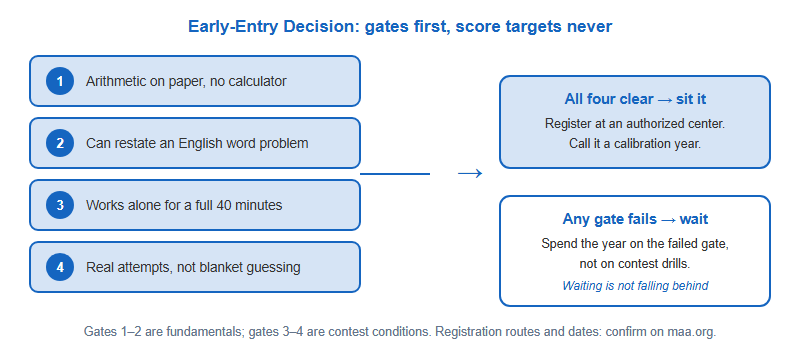
In our editorial work with China-based international-school families, the useful readiness test is not “is my child good at maths?” It is whether the student can survive the AMC 8’s four specific frictions without the paper becoming noise. Each gate can be checked at home in under an hour.
| Gate | What “ready” looks like | How to test it at home | If not yet |
|---|---|---|---|
| 1. Calculator-free arithmetic | Multi-digit multiplication, fractions and percentages done on paper without stalling | 20 mixed arithmetic items, pen and paper only, 10 minutes | Fix this first — it silently costs points on every domain |
| 2. English word problems | Reads a 3-sentence problem once and can restate what is being asked | Give 5 wordy problems; ask the student to say the question aloud before solving | Build reading-to-model fluency before adding contest difficulty |
| 3. Sustained 40 minutes | Works alone, seated, without prompts or a device, for a full 40-minute block | One silent 40-minute session with a timer | Practise the endurance separately — it is a habit, not a maths gap |
| 4. A foothold on the paper | Can genuinely attempt the earlier, more accessible questions rather than guessing throughout | Untimed run at an older practice set; count real attempts, not just correct answers | Wait a year; a paper answered mostly by guessing teaches nothing |
Notice what is not on this list: a target score. Setting a score target for a first early sitting is the single most reliable way to turn a useful experience into a discouraging one. Gate 4 is deliberately about attempts, not marks.
What Early Entry Actually Buys — and What It Costs
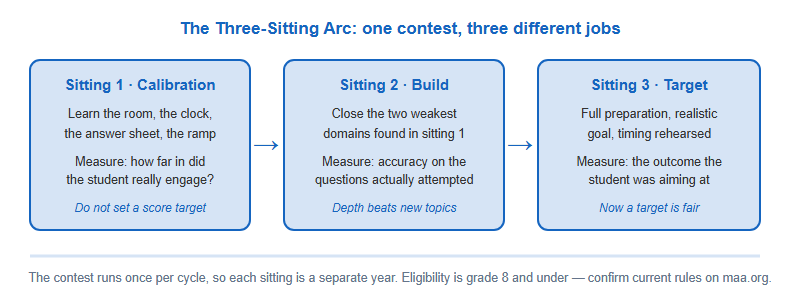
The AMC 8 runs once per cycle. That single fact is what makes the early-entry decision strategic rather than casual: a student who first sits it in Grade 8 gets one attempt, while a student who starts in Grade 6 gets three. But extra attempts are only an asset if each one produces information.
What you gain. The first sitting removes novelty — the unfamiliar room, the answer sheet, the discovery that the last third of the paper is much harder than the first third. It also produces the only genuinely honest diagnostic a family will get: performance under real time pressure, on unfamiliar problems, without help. Home practice never quite reproduces that. And it exposes the ramp early, so a student learns that leaving hard questions is normal strategy, not failure.
What it costs. Three risks, in the order we see them most often:
- Verdict framing. A young student who is told the score “shows how good you are at maths” can walk away from competition maths entirely. The same score, framed as a baseline, produces a plan.
- Burned practice material. Some families spend the autumn drilling the most recent past papers so the student “peaks” for an early sitting. Those papers are then no longer usable as clean diagnostics later, which matters far more in the target year — keep the recent sets in reserve and run early-year work on older material instead, which is what we have gathered in our AMC 8 study package and can send on request.
- Opportunity cost. If gates 1 and 2 are not clear, the months spent on contest-style problems would have paid more as arithmetic fluency and mathematical reading.
The cost column is why early entry should be a deliberate choice, not a default. The decision below is the one we would actually run.
How to Frame the Sitting by Grade
The same 40-minute paper should be given a different job depending on when a student sits it. This is the table we would hand a parent asking “what counts as a good outcome?”
| Grade at sitting | Job of this sitting | What to measure afterwards | What to ignore |
|---|---|---|---|
| Grade 5 or below | Exposure only, and only if all four gates are clear | Did the student stay engaged for the full 40 minutes? | The score, entirely |
| Grade 6 | Calibration — produce a real diagnostic | How far into the paper genuine attempts continued; which domains collapsed | Comparisons with older students |
| Grade 7 | Build — convert last year’s diagnostic into accuracy | Accuracy on questions attempted; careless-error rate | Any single question missed |
| Grade 8 | Target — the final eligible sitting | Whether the pre-agreed goal was met, and what the next contest step is | Regret about earlier years |
One nuance worth stating plainly: because the AMC 8 is pitched at the same level each cycle while the student keeps growing — individual papers still vary in difficulty — an honest year-on-year comparison is about which questions became reachable, not simply about a number going up. A student who attempted eight questions seriously in Grade 6 and eighteen in Grade 7 has made large progress even if the headline result moves less than the family expected. Recognition thresholds and how results are reported are set by the MAA each cycle — confirm those on maa.org rather than assuming last year’s figures carry over.
Make Sure You Are Registering for the Right “AMC”
This trips up families of younger students more than anyone else, because the competitions aimed at primary and lower-secondary ages are exactly the ones whose names collide:
- AMC 8 — the US American Mathematics Competitions, run by the MAA, the subject of this site.
- Australian AMC — a different competition run by the Australian Maths Trust, with its own divisions, timing and rules.
- AMO — the American Mathematics Olympiad organised by SIMCC (Singapore), again a separate event despite the “American” in its name.
They are not tiers of one another and results are not interchangeable. Before paying anything, check which organisation is named on the registration page. If your intention is the US AMC 8 specifically, the in-person, authorized-center route is described in our 2026–27 AMC 8 registration guide.
The Mistake We See Most Often
It is not entering too early. It is entering early without deciding in advance what the sitting is for. A Grade 6 student sat down with no agreed purpose will read whatever number comes back as a judgement, the family will react to it, and the genuine value — a clean map of which domains and which part of the ramp are currently out of reach — goes unused.
The fix costs nothing. Before the January window, write down two sentences: what this sitting is for, and what you will look at afterwards. Choose the review metric before you know the result. Families that do this get three usable years out of the AMC 8; families that do not often get one uncomfortable afternoon and quietly drop the whole thing.
Frequently Asked Questions
Can a Grade 5 student take the AMC 8?
Eligibility is grade 8 and under, so yes in principle. Readiness, not the rule book, should decide. Confirm current eligibility on maa.org.
Is there a minimum age for the AMC 8?
The stated limit is an upper age ceiling alongside the grade cap, not a minimum. Check the current wording on maa.org before assuming.
How many times can a student sit the AMC 8?
Once per cycle, in each year they remain eligible — so an early start can mean several sittings. Confirm the current schedule on maa.org.
Does a low early score hurt a student later?
Treat an early sitting as a private baseline for planning. Decide before the exam what you will measure and why.
This is an independent guide operated by Hanlin Education for China-based international-school students. It is not affiliated with, endorsed by, or sponsored by the Mathematical Association of America (MAA). Competition details change — always confirm current dates, eligibility, format, and registration rules on maa.org. Any error will be corrected within 7 working days.