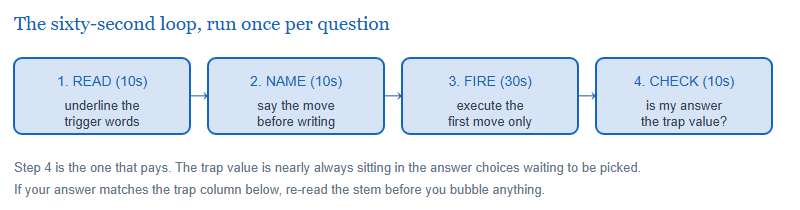
Under time pressure you do not classify a question by topic — you classify it by wording, in about four seconds, and then commit. This index is keyed that way. Find the phrase in the stem, read across, fire the first move, then check the trap column. Thirty entries, four tables, one drill at the end that takes ten minutes a week.
Why an index keyed by wording beats one keyed by topic
A syllabus map answers the question “what could they ask?” That is the right tool in September. It is the wrong tool at minute 19 of a 40-minute paper, when what you actually need is “this specific sentence in front of me — what do I write first?”
Competition problems telegraph their method through a small number of recurring phrases. “Without replacement” is not decoration; it is an instruction about the denominator. “Of the remaining” is an instruction to change the base. “At least one” is an instruction to count the complement. Students who have internalised these read the trigger and start correctly; students who have not read the whole stem, form a general impression, and start with whatever the topic usually needs.
This matters more on the AMC 8 than on a school test because every question is worth one mark out of 25 regardless of difficulty. A wrong first move on an easy question costs exactly as much as a wrong first move on a hard one, so the cheapest available gain is not learning harder mathematics — it is starting the questions you can already do in the right direction. The entries below reflect our own coaching observation of which words students routinely skate past; it is an editorial index rather than published data, and your own error log may add rows we have not listed.
Index 1: number, arithmetic and percent stems
| If the stem says… | First move | The trap it sets |
|---|---|---|
| “increased by … then decreased by” | Chain the multipliers, in order | Adding the two percentages together |
| “of the remaining” | Re-anchor: the base has just changed | Taking the percentage of the original total |
| “the units digit of” | Write out the cycle of last digits, then divide the exponent by the cycle length | Off-by-one when indexing into the cycle |
| “leaves a remainder of” | Write the number as multiple + remainder, then list the smallest candidates | Treating it as an equation to solve rather than a list to search |
| “divisible by both … and” | Use the least common multiple | Multiplying the two divisors when they share a factor |
| “how many integers between A and B, inclusive” | Count B − A + 1, then adjust for the step size | Dropping the +1 |
| “the least possible” / “the greatest possible” | Push each quantity to its bound and test the extremes | Assuming the answer sits at a comfortable middle value |
| “consecutive integers” | Name them n, n+1, n+2 before anything else | Guessing numbers before introducing a variable |
Index 2: counting, probability and statistics stems
| If the stem says… | First move | The trap it sets |
|---|---|---|
| “in how many ways” | Decide first whether the choices are independent (multiply) or split into cases (add) | Mixing multiplication and addition inside one line of working |
| “at least one” | Count the complement: total minus none | Trying to enumerate the “at least” cases directly |
| “without replacement” | Shrink the denominator on every subsequent draw | Reusing the original denominator |
| “with replacement” | Keep the denominator constant; the draws are independent | Shrinking it anyway, out of habit from the previous question |
| “must not” / “cannot be adjacent to” | Count everything, then subtract the forbidden arrangements | Trying to build only the valid arrangements from scratch |
| “the average” or “the mean of” | Convert every mean into a total on the first line | Adding or subtracting the means themselves |
| “the median” | Sort the list, every time, even when it looks sorted | Taking the middle entry of an unsorted list |
| “what fraction of” | State the whole explicitly before writing any fraction | Dividing by the wrong whole |
Index 3: geometry and measurement stems
| If the stem says… | First move | The trap it sets |
|---|---|---|
| “the area of the shaded region” | Name the whole and the removed piece: area = whole − part | Attacking the irregular shape directly |
| “the area of triangle …” inside a figure | Name the base and its perpendicular height out loud before computing | Hunting for a height that the figure already gave you |
| “the perimeter of” a composite figure | Trace the outer boundary with a finger; internal edges do not count | Adding every side length of every component piece |
| “similar” or “the same shape as” | Write the ratio of corresponding sides; remember areas scale by its square | Scaling the area by the linear factor instead of its square |
| “the diagonal of” | Pythagoras — applied twice if the solid is three-dimensional | Adding the edge lengths together |
| “folded”, “rotated” or “reflected” | Track one labelled point through the transformation | Trying to re-imagine the entire figure at once |
| “the volume of” a solid built from another | Compare with the original by ratio rather than rebuilding | Recomputing from scratch and losing ninety seconds |
Index 4: algebra, sequence and logic stems
| If the stem says… | First move | The trap it sets |
|---|---|---|
| “the ratio of A to B is” | Write the parts as multiples of k | Treating the ratio numbers as the actual quantities |
| “twice as many … as” | Translate one clause at a time into symbols | Putting the multiplier on the wrong side of the equation |
| “each term is obtained by” | Generate terms until a repeat or pattern appears | Searching for a closed formula that does not exist |
| “the nth term” of a constant-step pattern | First term plus (n − 1) steps | Multiplying the step by n instead of n − 1 |
| “if … then” conditions on several people or objects | Build a small grid of the possibilities | Reasoning it through in prose and losing track |
| “at the same time”, “meet”, “catch up” | Work in a shared quantity: total distance, or work done per unit time | Averaging the two speeds |
| “how many … satisfy” | Bound the search first, then test the integers inside the bound | Testing values at random with no bound, and stopping early |
How to drill with the index without solving anything
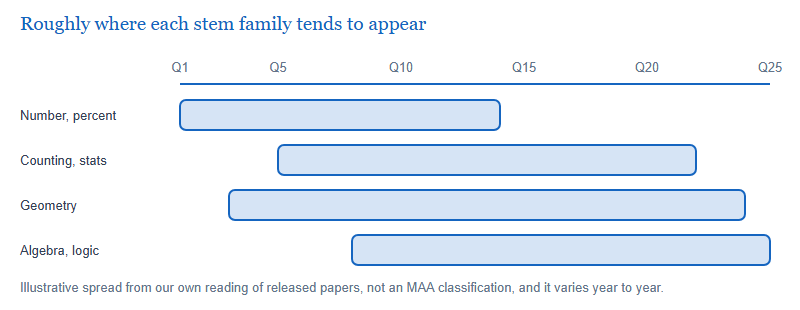
The mistake is to treat this as reading material. It is a drill sheet, and the drill deliberately removes the solving so that all your attention lands on recognition.
- Take a released past paper and do not solve it. Set a ten-minute timer for all 25 questions.
- Annotate each question with two things only: the trigger phrase you can see in the stem, and the first move it demands. Two or three words each.
- Mark your annotations against this index, not against the official answers. You are testing recognition, not arithmetic.
- Any question where you could not name a trigger goes on a list. That list is your real weakness — not the questions you got wrong, but the ones you could not classify.
- Repeat weekly on a fresh paper. In our own coaching, recognition speed tends to improve faster than problem-solving ability, which is why we treat this as one of the highest-return ten minutes in a weekly plan.
Two refinements once the basic drill feels easy. First, add a third annotation: the trap value, computed. On a multiple-choice paper the trap is usually sitting in the options, and being able to predict which letter is the bait is a genuinely different skill from solving. Second, do the drill in both languages if your paper is bilingual — triggers you recognise instantly in one language can vanish in the other, and that gap is worth finding in October rather than in the exam room.
Finally, keep the recognition work separate from the logistics work. This drill assumes you already have a confirmed sitting; if that is not yet settled, our guide to the in-person January AMC 8 for China-based families covers finding a centre and the dates that go with it. Recognition improves on your schedule, but registration runs on somebody else’s.
Frequently asked questions
Is thirty triggers enough to cover a whole paper?
No index covers everything, but these thirty phrases recur constantly. Add your own rows from your error log as you find them.
Should I memorise this table?
Memorise the first-move column. The stems you will recognise naturally once you have annotated three or four past papers.
What if a question contains two triggers?
Common on later questions. Fire the more restrictive move first — usually the counting or replacement instruction — then the second.
Does this replace learning the mathematics?
No. It stops you starting correct mathematics in the wrong direction. The topic work still has to happen alongside it.
This is an independent guide operated by Hanlin Education for China-based international-school students. We are not affiliated with, endorsed by, or sponsored by the Mathematical Association of America (MAA). The index above is our own editorial classification rather than official MAA material, and competition format, scoring and rules change between cycles — confirm all current details on maa.org and with your test centre before acting. Any error brought to our attention is corrected within 7 working days.