Teaching illustration: The following examples are original pedagogical constructions designed to demonstrate common reasoning errors. They are not official AMC 8 contest problems, nor do they represent MAA scoring rules or answer-key conventions.
For many students preparing for the American Mathematics Competition 8 (AMC 8), fraction word problems present a specific cognitive hurdle. The difficulty often lies not in arithmetic execution—adding or multiplying fractions—but in correctly interpreting the relationship between parts and wholes within the problem statement. A common error is applying a fraction to the wrong base quantity, leading to an answer that seems plausible but is logically inconsistent. This article focuses on this specific reasoning failure through worked hypothetical examples, distinct from broader preparation strategies covered in AMC 8 Past Papers: Building a Repeatable Diagnostic Cycle With Error Logging.
The Core Challenge: Identifying the Reference Whole
In AMC 8 problems, phrases like “half of the remaining” or “one-third more than” require precise identification of what constitutes the “whole” at each step. If the reference whole shifts during the problem, calculating based on the initial total will yield incorrect results. The following teaching illustrations demonstrate both correct reasoning and explicitly worked incorrect reasoning, so you can see exactly where the logic breaks.
Hypothetical Case 1: Sequential Reductions
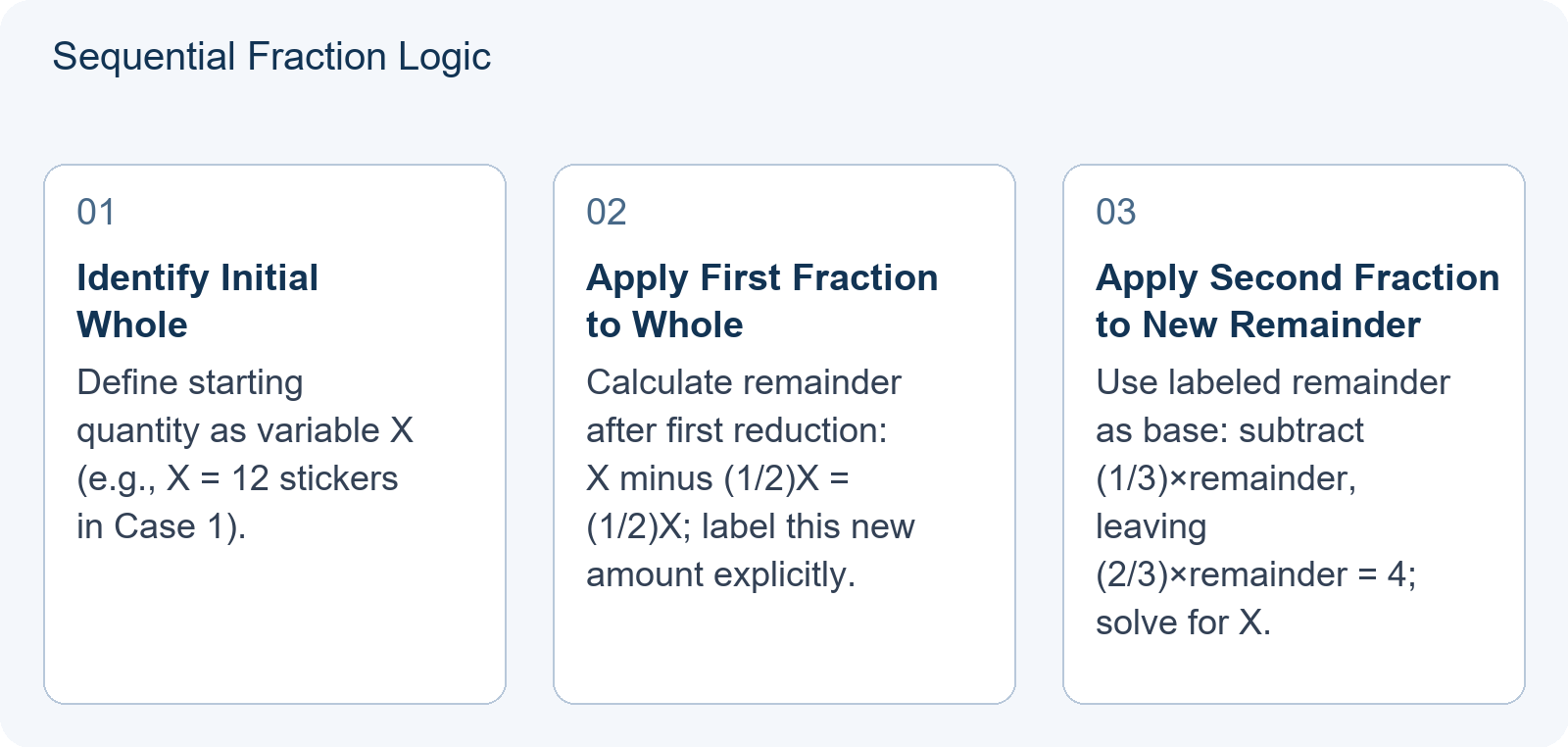
Problem: A student has a certain number of stickers. They give away half of their stickers to a friend, then give one-third of the remaining stickers to another friend. They have 4 stickers left. How many did they start with?
Correct Solution:
- Step 1: After giving away one-third of the remainder, two-thirds of the remainder equals 4 stickers. So the remainder before the second gift was 4 ÷ (2/3) = 4 × (3/2) = 6 stickers.
- Step 2: These 6 stickers represent half of the original amount. Thus, the original amount was 6 × 2 = 12 stickers.
- Verification: Start with 12. Give away half (6), leaving 6. Give away one-third of 6 (2), leaving 4. This matches the problem statement.
The Common Mistake—Worked Incorrectly:
A student adds the fractions: 1/2 + 1/3 = 3/6 + 2/6 = 5/6 given away, leaving 1/6. They set 1/6 of the original equal to 4, obtaining 4 × 6 = 24 stickers. Why this fails: The second fraction, one-third, applies to the remaining half—not the original total. One-third of the remaining half is (1/3) × (1/2) = 1/6 of the original. The correct total given away is 1/2 + 1/6 = 4/6 = 2/3, leaving 1/3. One-third of 12 is 4, confirming the correct answer. The error of adding 1/2 + 1/3 directly double-counts the base for the second fraction.
Hypothetical Case 2: Comparative Fractions
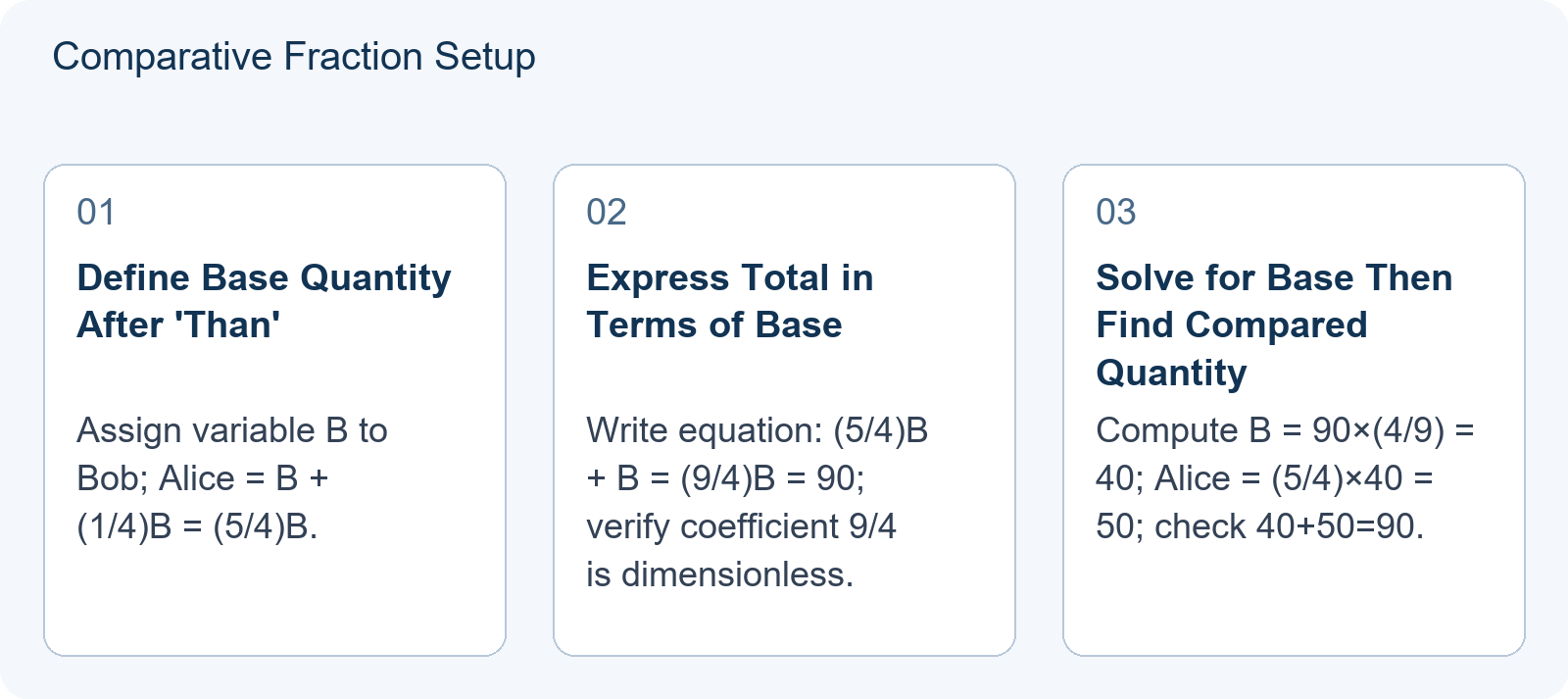
Problem: Alice has one-fourth more apples than Bob. Together they have 90 apples. How many does Alice have?
Correct Solution:
- Step 1: Let Bob’s apples be B. Alice has B + (1/4)B = (5/4)B.
- Step 2: Set up the equation: (5/4)B + B = (9/4)B = 90. Solving: B = 90 × (4/9) = 360/9 = 40.
- Step 3: Alice has (5/4) × 40 = 200/4 = 50 apples. Verification: 40 + 50 = 90. All values are integers, which is typical for problems involving indivisible objects like apples.
The Common Mistake—Worked Incorrectly:
A student treats “one-fourth more” as “one-fourth of the total.” They calculate (1/4) × 90 = 22.5, round mentally to 23, and assign Alice 23, leaving Bob 67. Why this fails: First, 22.5 is not an integer, but whole apples cannot be split, so the context requires an integer solution. Second, the phrase “one-fourth more than Bob” defines Alice relative to Bob, not relative to the total. The base is Bob’s amount, not 90. Another variant: a student writes Alice = Bob + 1/4 without attaching the 1/4 to Bob’s quantity, treating it as a raw number rather than a fraction of a base. Both errors disappear when you explicitly write Alice = (5/4) × Bob before touching the total of 90.
Diagnostic Table: Two Error Types to Watch For
| Error Type | Description | Correction Strategy | Grounded In |
|---|---|---|---|
| Static Whole Assumption | Applying subsequent fractions to the original total instead of the current remainder. | Track the “current amount” explicitly after each operation; label it clearly. | Case 1 incorrect calculation |
| Base Confusion in Comparisons | Misidentifying the base in “X% more than Y” or “X/Y more than Z” statements. | Write equations using variables (e.g., A = 1.25B); identify the entity after “than”. | Case 2 incorrect calculation |
Targeted Practice Sequence
To address these specific issues, students should engage in focused drills rather than random problem solving. Start with simple two-step fraction problems where the second fraction clearly references the result of the first. Progress to comparative problems involving percentages or ratios. For broader context on competition structure, refer to our AMC 8 Score: Converting Raw Results Into a Next-Step Decision Framework.
When practicing, always ask: “What is the whole right now?” before performing any calculation. This habit prevents the most frequent logical errors in AMC 8 fraction questions. Additionally, reviewing past papers can help identify recurring patterns in how these relationships are framed. For more worked examples of these concepts, see our guide on AMC 8 Past Papers: Building a Repeatable Diagnostic Cycle With Error Logging.
Demonstrating Mastery
A learner has mastered this skill when they can consistently solve multi-step fraction problems without needing to re-read the question to check if a fraction applies to the original or remaining amount. They should be able to articulate why a particular calculation method works by identifying the changing reference whole throughout the problem. A useful practice target is to solve such problems efficiently, though speed varies by individual comfort level.
Frequently Asked Questions
Why do I get different answers when I add fractions versus working backward?
Adding fractions assumes they apply to the same whole. Working backward respects that each fraction applies to the current remaining amount, which changes after each step. In Case 1, adding 1/2 + 1/3 treats both as fractions of the original; the second is actually a fraction of the remainder.
How can I quickly tell if a fraction refers to the original or remaining amount?
Look for keywords like ‘of the remaining’, ‘left over’, or ‘after’. If absent, check if the subject is being compared to another entity (like ‘more than Bob’), which implies a different base. Always pause to label your base before calculating.
Are these types of problems common in recent AMC 8 competitions?
Fraction and ratio word problems frequently appear in the AMC 8 syllabus, often testing reading comprehension alongside mathematical execution. While exact frequency varies by year, these concepts are core to the competition’s algebraic reasoning domain. The specific teaching illustrations above are original constructions for practice, not official past problems.