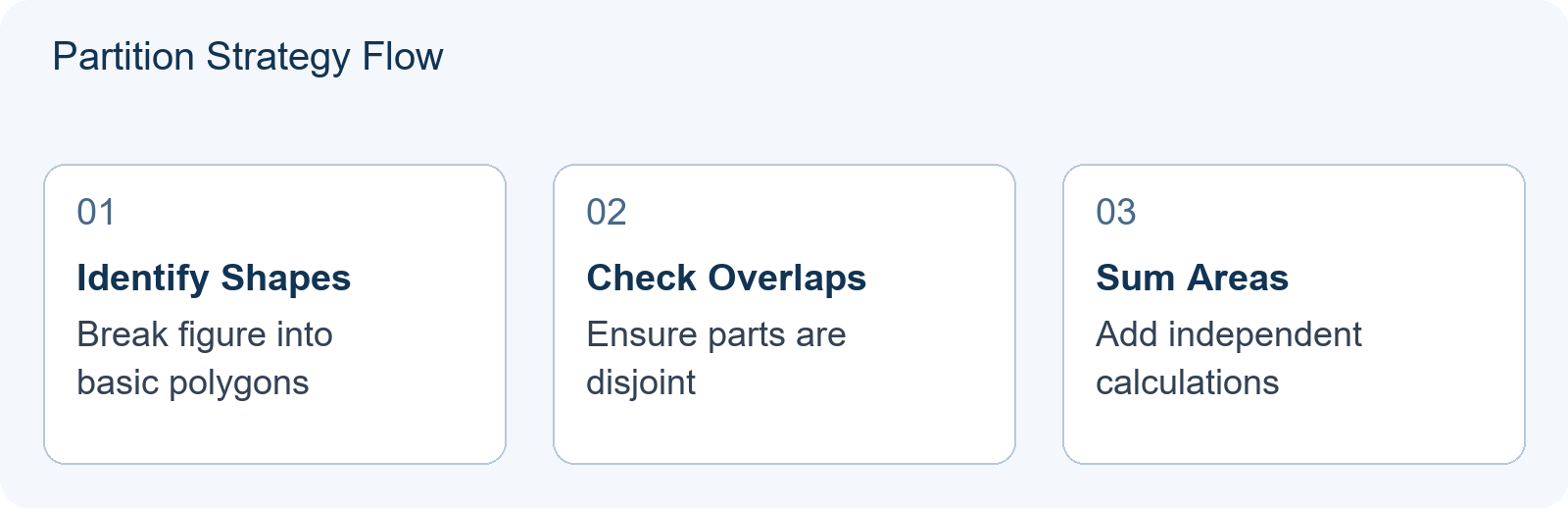
When students encounter shaded region problems in the AMC 8, a common error is attempting to calculate the area of the entire figure and then subtracting the unshaded parts without checking for overlaps. This approach often leads to double-counting or double-subtracting areas, resulting in incorrect answers. The key to solving these problems reliably is partitioning: breaking the figure down into smaller, non-overlapping shapes whose areas can be calculated independently and summed.
Why Overlapping Regions Cause Double Subtraction
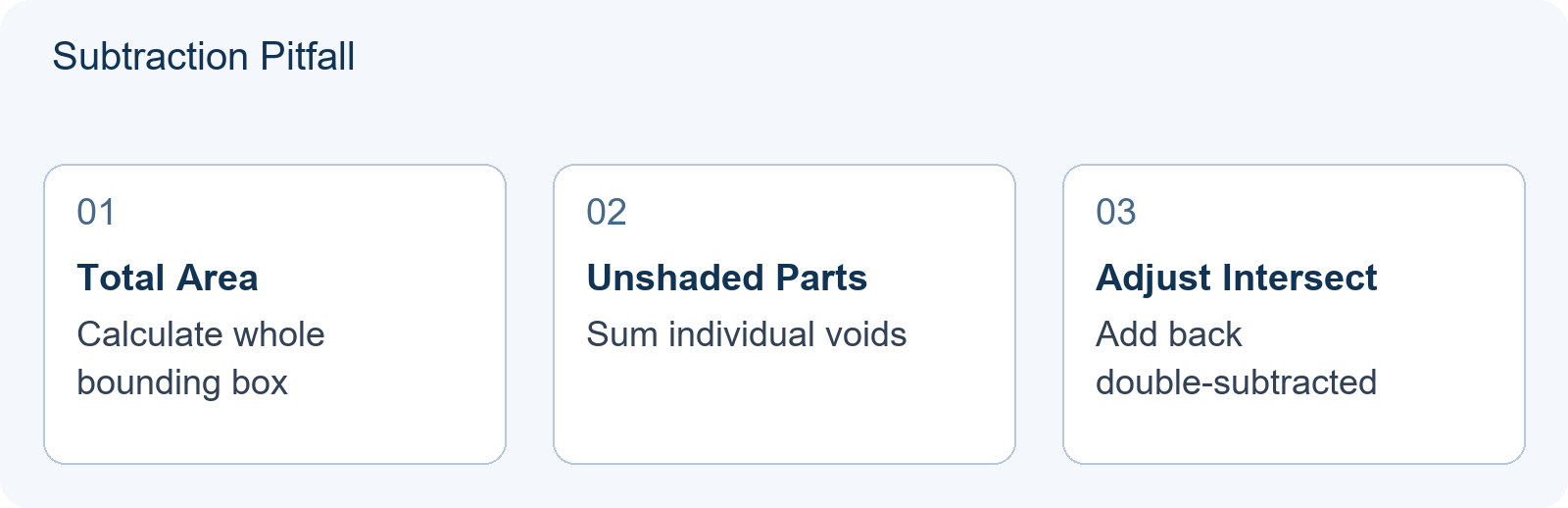
In many AMC 8 geometry questions, the “unshaded” regions are not disjoint. If you define the unshaded area as the union of several shapes (e.g., two rectangles inside a larger figure), simply adding their individual areas will overcount the intersection. Conversely, if you try to find the shaded area by subtracting the sum of unshaded parts from the total, you must account for any overlap between those unshaded parts. Failing to do so means you have subtracted the intersection twice.
The most robust strategy is to avoid subtraction where possible. Instead, identify the specific geometric components that make up the shaded region directly. If the shaded region is complex, divide it into standard shapes—rectangles, triangles, semicircles—that do not overlap. Calculate each part’s area and add them together. This method eliminates the risk of inclusion-exclusion errors entirely.
A Labelled Original Two-Rectangle Overlap Example
Teaching Illustration: Consider a large rectangle with dimensions 10 × 6. Inside this rectangle, there are two smaller rectangles that overlap. Rectangle A has dimensions 4 × 3 and is positioned with its bottom-left corner at the origin and its top-right corner at (4, 3). Rectangle B has dimensions 5 × 2 and is positioned with its bottom-left corner at (2, 1) and its top-right corner at (7, 3). The shaded region is defined as the area inside the large rectangle but outside both Rectangle A and Rectangle B.
The overlap region has width from max(0, 2) to min(4, 7) = 2 to 4, so width 2; and height from max(0, 1) to min(3, 3) = 1 to 3, so height 2. Wait—let us recalculate: Rectangle A spans x ∈ [0, 4], y ∈ [0, 3]; Rectangle B spans x ∈ [2, 7], y ∈ [1, 3]. The intersection spans x ∈ [2, 4], y ∈ [1, 3], giving dimensions 2 × 2 = 4. Correcting: Area(A) = 12, Area(B) = 10, overlap = 4. True unshaded area = 12 + 10 − 4 = 18. Total area = 60. Shaded area = 60 − 18 = 42.
If a student calculates unshaded area as Area(A) + Area(B) = 22, they overcount by 4. They would compute shaded = 60 − 22 = 38, which is incorrect. By partitioning the unshaded region into three non-overlapping parts (A only, B only, and A ∩ B), we verify: Area(A only) = 12 − 4 = 8; Area(B only) = 10 − 4 = 6; Area(Overlap) = 4. Total unshaded = 8 + 6 + 4 = 18. Shaded = 60 − 18 = 42.
A Contrasting Shaded-Frame Example
Teaching Illustration: Imagine a square frame formed by removing a smaller concentric square from a larger one. The outer square has side length 8, and the inner square has side length 4. The inner square is centered within the outer square and fully contained, with sides parallel to the outer square. The shaded region is the frame itself.
Total Area = 8² = 64. Inner Area = 4² = 16. Shaded Area = 64 − 16 = 48.
In this case, subtraction works cleanly because the inner square is completely contained within the outer square with no partial overlaps or multiple intersecting shapes complicating the boundary. Note that rotating the inner square while keeping it fully contained does not change the area calculation: the inner square remains entirely inside, so outer-minus-inner still yields the correct frame area. Only when a shape crosses the boundary of another does the setup change and require more careful analysis.
An Additional Geometric Worked Case: Concentric Circles Frame
Teaching Illustration: A circular running track is formed by two concentric circles with radii 10 and 6. The shaded region is the track itself (the annulus between the two circles). Find the shaded area.
Partitioning approach: The shaded region is already a single standard shape—an annulus. We compute it by subtraction of non-overlapping nested areas. Area of outer circle = π × 10² = 100π. Area of inner circle = π × 6² = 36π. Shaded area = 100π − 36π = 64π.
Verification by direct partition: We cannot easily cut the annulus into rectangles, but we can verify the subtraction is valid because the inner circle is fully contained within the outer circle. The two regions share no boundary-crossing complications. If the inner circle were offset so it partially exited the outer circle, the subtraction would fail and we would need to partition or use inclusion-exclusion.
How to Choose a Partition Versus Inclusion-Exclusion
Use partitioning when the shaded region consists of distinct, identifiable chunks that do not share boundaries in complex ways. This is often easier visually. Use inclusion-exclusion (Total − Sum(Parts) + Overlaps) when the unshaded regions are clearly defined but overlap significantly, making it hard to see the shaded chunks directly.
To decide which method to apply, run through this three-question checklist before writing any area formula:
- Can I see the shaded region as separate pieces? If yes, draw the dividing lines and use partition. If the shaded region is everything left over after removing multiple shapes, you likely need inclusion-exclusion.
- Do the unshaded parts touch or cross each other? If they share any interior point, their areas are not disjoint. You must subtract their intersection once from the sum of their individual areas.
- Would a single auxiliary line turn one complex shape into two simple ones? AMC 8 figures often contain hidden symmetry. A horizontal or vertical cut through the center frequently splits an overlapping figure into manageable rectangles or triangles.
For more general geometry strategies, refer to our guide on The AMC 8 Geometry Reference Card: 12 Configurations, the Formula Set Worth Memorising, and Why Nothing on the Page Can Be Measured, which covers standard configurations and formula sets.
Three Original Diagnostic Exercises With Worked Answers
Exercise 1: The Cross Shape
A cross shape is formed by five identical squares arranged in a plus sign. Each square has side length 2. What is the area of the cross?
Solution: Partition the cross into 5 non-overlapping squares. Area of one square = 2 × 2 = 4. Total area = 5 × 4 = 20. No subtraction needed.
Exercise 2: Overlapping Circles in a Rectangle
A rectangle is 10 × 5. Two circles of radius 2 are placed inside, centered at (3, 2.5) and (7, 2.5). Do the circles overlap? What is the area of the rectangle not covered by circles?
Solution: Distance between centers = 7 − 3 = 4. Sum of radii = 2 + 2 = 4. The circles touch externally at exactly one point, so their intersection has area zero. For practical area computation, this means the union area equals the sum of individual areas. Area of one circle = πr² = 4π. Total circle area = 8π. Rectangle area = 50. Uncovered area = 50 − 8π. Because the touch point has no area, simple subtraction yields the correct result, but the reasoning requires recognizing that the circles are not disjoint in a way that creates overlapping area.
Exercise 3: The L-Shaped Region
An L-shape is formed by removing a 3 × 3 square from the top-right corner of a 6 × 6 square. What is the area of the remaining L-shape?
Solution: Total area = 36. Removed area = 9. Remaining area = 27. Alternatively, partition the L-shape into two rectangles: a 6 × 3 vertical strip and a 3 × 3 horizontal strip attached to its bottom. Area = 18 + 9 = 27. Both methods yield the same result, confirming accuracy. A third verification: partition into a 3 × 6 horizontal strip and a 3 × 3 vertical strip below it, giving 18 + 9 = 27 again.
For students building systematic geometry skills, reviewing foundational counting and spatial reasoning helps. See AMC 8 Counting and Probability: The Four Setups That Cover Almost Every Question for complementary techniques, and AMC 8 Cubes, Nets and Views: The Spatial Reasoning Card With Four Lookup Tables and a 10-Problem Worked Key for spatial partitioning practice that reinforces the same visual decomposition mindset.
Use the Error Pattern to Select the Next Practice Task
If you consistently miss overlapping area questions, your issue is likely not arithmetic but conceptual setup. You may be trying to force a single formula onto a composite figure. The next step is to practice drawing auxiliary lines to create partitions. Start with simple composite shapes like Ls, Ts, and crosses before moving to curved intersections.
Track your errors by noting whether the mistake was arithmetic (calculation), conceptual (wrong method), or visual (misidentifying the shaded region). If more than half your errors in geometry are conceptual, spend two sessions on partition-only problems before attempting inclusion-exclusion again. This targeted approach converts a weak area into a reliable source of points on test day.
Frequently Asked Questions
Can I always use subtraction for shaded areas?
No. Subtraction works best when unshaded regions are disjoint or when one shape is fully contained within another without boundary crossings. If they overlap partially, you must adjust for the intersection or partition the shaded region directly.
What if the figure has curves?
Treat curved sections as sectors or segments. Partition the figure into rectangular and circular components, ensuring no overlap between your chosen sub-regions. For concentric circles, subtraction is valid because the inner shape is fully contained.
Is there a shortcut for symmetric figures?
Yes. Calculate the area of one symmetric quadrant or half, then multiply by the number of symmetries. This reduces calculation errors and simplifies partitioning. For nested concentric shapes, symmetry confirms that rotation does not affect the area calculation.