For many students preparing for the American Mathematics Competition 8 (AMC 8), the transition from standard classroom math to competition-style problems involves a subtle but critical shift in logic. A common pitfall is finding a mathematically correct algebraic solution that, upon closer inspection, violates the implicit or explicit constraints of the problem—specifically, integer requirements.
This article addresses a specific reasoning failure: assuming that because an equation balances, the resulting value is a valid answer choice. In AMC 8, which consists of 25 multiple-choice questions completed in 40 minutes, speed and accuracy are paramount. However, accuracy often hinges on recognizing when a variable must be a whole number, positive, or within a specific range, even if the algebra does not explicitly state “x must be an integer.”
Why the AMC 8 Multiple-Choice Format Punishes Non-Integer Answers
The AMC 8 answer format fundamentally shapes what constitutes a valid solution. Each question offers five options labeled A through E. When a problem involves discrete quantities—people, objects, days, or geometric units—the correct answer must be a whole number that actually works in context. The test designers deliberately include distractors derived from common algebraic missteps: the rounded value, the fractional result, or the negative solution that emerges from technically correct manipulation.
Consider how a distractor is constructed. If a problem asks for the number of items and the correct answer is 7, the test writers might include 6.33 as a distractor by designing the algebra to produce that value if the student forgets the integer constraint. A student who arrives at 6.33 and selects 6 because it is “close enough” has fallen into a precisely laid trap. The AMC 8 rewards the student who pauses to ask: “Does this number make sense in the real-world scenario described?”
This means the competition does not merely test whether you can solve an equation. It tests whether you can interpret the solution. The multiple-choice format amplifies this challenge because one of the five options will almost always match the result of flawed reasoning, tempting you to stop thinking one step too early.
The Nature of Hidden Constraints
In standard algebra classes, solving for x usually yields a real number. If x = 3.5, that is often considered a complete answer. In competition mathematics, particularly at the AMC 8 level, context dictates validity. Problems involving people, objects, days, or discrete geometric units inherently require integer solutions. When a student solves an equation and gets a non-integer result, they may incorrectly assume their calculation is wrong, or worse, select the nearest integer without verifying if it satisfies the original condition.
Consider the difference between a continuous model and a discrete reality. AMC 8 problems frequently blend these. For instance, a problem might ask for the number of ways to arrange items, or the minimum cost where prices are fixed integers. If your algebraic derivation leads to a fractional count of items, the error is not necessarily in the arithmetic—it is in the interpretation of the domain.
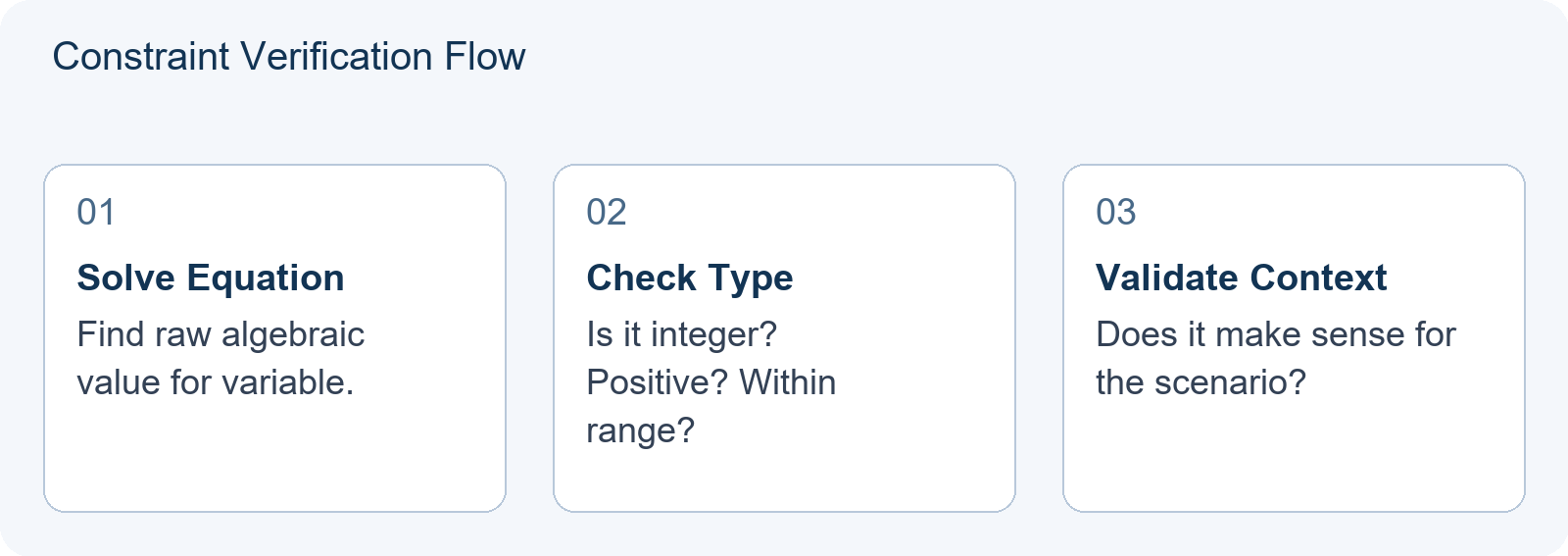
Teaching Illustration 1: The Discrete Object Fallacy
Teaching Illustration: A school is buying notebooks and pens. Notebooks cost $3 each and pens cost $2 each. A teacher spends exactly $29. What is the maximum number of notebooks she could have bought if she bought more notebooks than pens?
A student might set up the equation 3n + 2p = 29, where n is notebooks and p is pens. They might try to solve for n by isolating variables or testing values. Suppose they rearrange it as n = (29 – 2p) / 3. If they guess p = 5, then n = (29 – 10) / 3 = 19 / 3 ≈ 6.33. A hurried student might round this to 6 and check if 3(6) + 2(5) = 28, which is close but not 29. They might then panic, thinking they made a calculation error, or worse, select 6 from the answer choices because it appears after rounding.
The Correct Approach: Recognize that n and p must be non-negative integers. Instead of rounding, test integer values for p that make (29 – 2p) divisible by 3.
- If p = 1, then 29 – 2 = 27, and 27/3 = 9. So n = 9. Check: 3(9) + 2(1) = 27 + 2 = 29. Valid. Also 9 > 1, satisfying the constraint.
- If p = 4, then 29 – 8 = 21, and 21/3 = 7. So n = 7. Check: 3(7) + 2(4) = 21 + 8 = 29. Valid. But 7 > 4 is true, so this also satisfies the constraint.
- If p = 7, then 29 – 14 = 15, and 15/3 = 5. So n = 5. Check: 3(5) + 2(7) = 15 + 14 = 29. Valid. But 5 > 7 is false, violating the constraint.
The condition “more notebooks than pens” eliminates n = 5, leaving n = 9 and n = 7 as valid candidates. Since the question asks for the maximum number of notebooks, the correct answer is 9. The key takeaway: Do not accept 6.33 as a near-miss. Reject it immediately because you cannot buy a fraction of a notebook, and verify which integer solution satisfies all stated conditions and optimization goals.
Teaching Illustration 2: The Geometric Domain Restriction
Teaching Illustration: A rectangle has integer side lengths and an area of 12. What is the minimum possible perimeter?
Students often recall the formula P = 2(l + w) and A = lw = 12. They might use calculus intuition or simply guess that a square minimizes perimeter. If they assume l = w, then l² = 12, so l = √12 ≈ 3.46. Then P ≈ 2(3.46 + 3.46) = 13.84. They might look for an answer choice like 14.
The Constraint Check: The problem specifies integer side lengths. √12 is not an integer. Therefore, the square configuration is invalid. We must list factor pairs of 12 with both factors as positive integers: (1, 12), (2, 6), (3, 4). Calculate perimeters:
- 1, 12 → P = 2(13) = 26
- 2, 6 → P = 2(8) = 16
- 3, 4 → P = 2(7) = 14
The minimum is 14. While the numerical answer happens to match the rounded approximation from the square assumption, the reasoning was fundamentally flawed. If the area were 13, the square root method would yield P ≈ 14.4, suggesting 14 or 15, but integer factors are only (1, 13), giving P = 28. Rounding the irrational result would lead to a completely wrong answer. The integer constraint is not a minor detail—it is the entire problem.
Diagnostic Table: Identifying the Error
| Symptom | Likely Cause | Action |
|---|---|---|
| Answer is a decimal or fraction | Variable represents discrete items (people, cars, coins) | Reject; find exact integer satisfying all conditions |
| Answer is negative | Context implies quantity or length | Reject; check for extraneous roots |
| Multiple answers fit algebraically | Missing inequality constraint (e.g., “more than”) | Re-read prompt for comparative language |
| Algebra seems too complex | Integer trial-and-error is faster | Switch to systematic listing of factors |
Targeted Practice Strategy
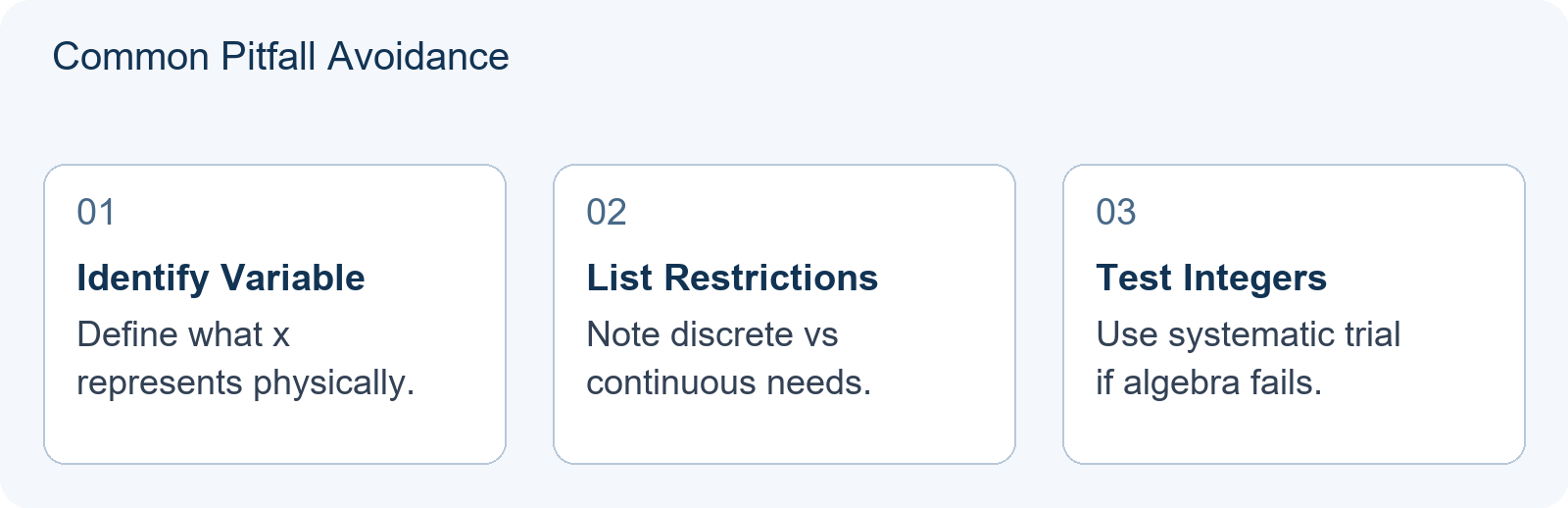
To master this skill, students should practice “constraint-first” reading. Before writing any equations, identify what kind of numbers the variables represent. Are they counts? Lengths? Prices? This mental checklist prevents the “algebraic tunnel vision” where one solves for x without asking “what does x mean?”
When you encounter a word problem, pause after the first sentence to classify the variables. If the problem mentions objects, people, or discrete units, immediately flag that integer solutions are required. If the problem involves measurements, check whether the context permits fractions or demands whole numbers. This habit transforms a common source of errors into a reliable point-scoring opportunity.
Build speed by practicing systematic factor listing for small numbers. For any product under 50, you should be able to list all factor pairs in under ten seconds. This skill directly supports geometry problems with integer constraints and Diophantine equation problems alike.
For further preparation, review our guide on AMC 8 Past Papers: Building a Repeatable Diagnostic Cycle With Error Logging to track your errors, and explore AMC 8 Score: Converting Raw Results Into a Next-Step Decision Framework to understand how scores inform your study plan. Additionally, check AMC 8 Registration: Which Channel Fits Your Situation Before the 2027 Window Closes for registration logistics.
The goal is not just to get the right number, but to understand why other plausible-looking numbers are disqualified. This depth of reasoning is what separates a good score from a top-tier achievement in the AMC 8.
Frequently Asked Questions
Why do I keep getting decimals in AMC 8 word problems?
This usually indicates that the variable represents a discrete quantity (like number of items or people) which must be an integer. Re-evaluate your setup or use integer trial-and-error methods instead of pure algebraic isolation.
Should I round my answer if it is close to an integer?
No. In AMC 8, if the context requires an integer, a non-integer result means your current solution path is incorrect or incomplete. You must find the exact integer value that satisfies all conditions, not the closest approximation.
How can I practice identifying these constraints quickly?
Review past papers focusing on Diophantine equations (integer solutions) and geometry problems with integer side lengths. Practice listing factor pairs before attempting complex algebraic manipulations, and always classify your variables before solving.