AMC 8 Venn diagram problems often look simple until you need to sort participants into overlapping categories. The challenge is not drawing the circles—it is translating phrases like “exactly one,” “at least one,” and “neither” into correct region counts without double-counting or leaving gaps. This article works through two teaching illustrations, shows where a tempting shortcut fails, and offers a decision framework you can use immediately.
Why These Three Phrases Trip Students Up
On AMC 8, Venn diagram questions typically present two or three categories—sports, subjects, activities—and ask for a specific subset. The wording is precise:
- Exactly one means in one category only, not the overlap.
- At least one means one or more categories, including all overlaps.
- Neither means outside all categories.
The trap is treating “at least one” as “exactly one” or forgetting that “neither” still belongs to the total. A reliable first step is to label every region before filling numbers.
Teaching Illustration 1: Two-Circle Sports Club
The following is an original teaching illustration, not an official AMC 8 problem.
Suppose a school has 40 students. Some play basketball, some play chess, some play both, and some play neither. You are told:
- 20 play basketball
- 15 play chess
- 8 play both
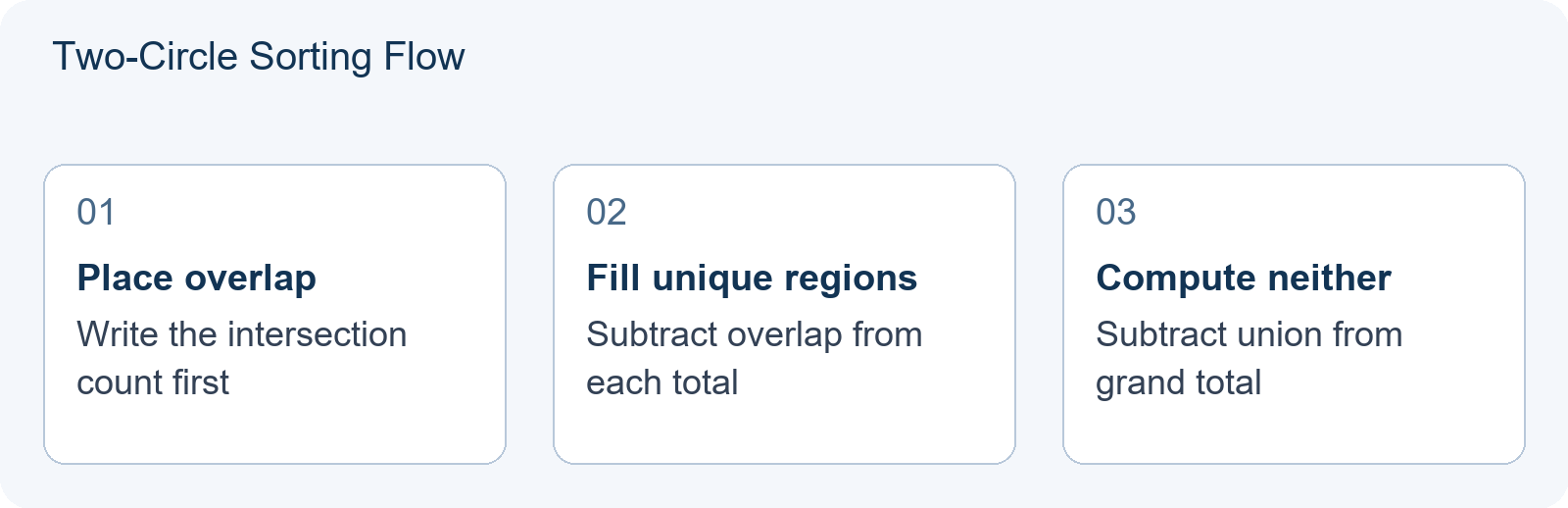
Step 1: Place the overlap. Eight students play both, so write 8 in the intersection.
Step 2: Fill the unique regions. Basketball-only = 20 − 8 = 12. Chess-only = 15 − 8 = 7.
Step 3: Find “neither.” Total accounted for so far: 12 + 8 + 7 = 27. Neither = 40 − 27 = 13.
Now answer the three target questions:
| Question | Calculation | Answer |
|---|---|---|
| Exactly one sport | Basketball-only + Chess-only = 12 + 7 | 19 |
| At least one sport | 12 + 8 + 7 (all inside circles) | 27 |
| Neither sport | 40 − 27 | 13 |
Notice that “at least one” is the entire union, while “exactly one” deliberately excludes the overlap.
Teaching Illustration 2: Three-Circle Academic Contest
The following is an original teaching illustration, not an official AMC 8 problem.
Now consider three subjects: Math, Science, and Coding. In a group of 100 students, the disjoint region counts are:
- Math only = 20
- Science only = 25
- Coding only = 15
- Math ∩ Science only = 10
- Math ∩ Coding only = 8
- Science ∩ Coding only = 6
- All three = 5
- None of these subjects = 11
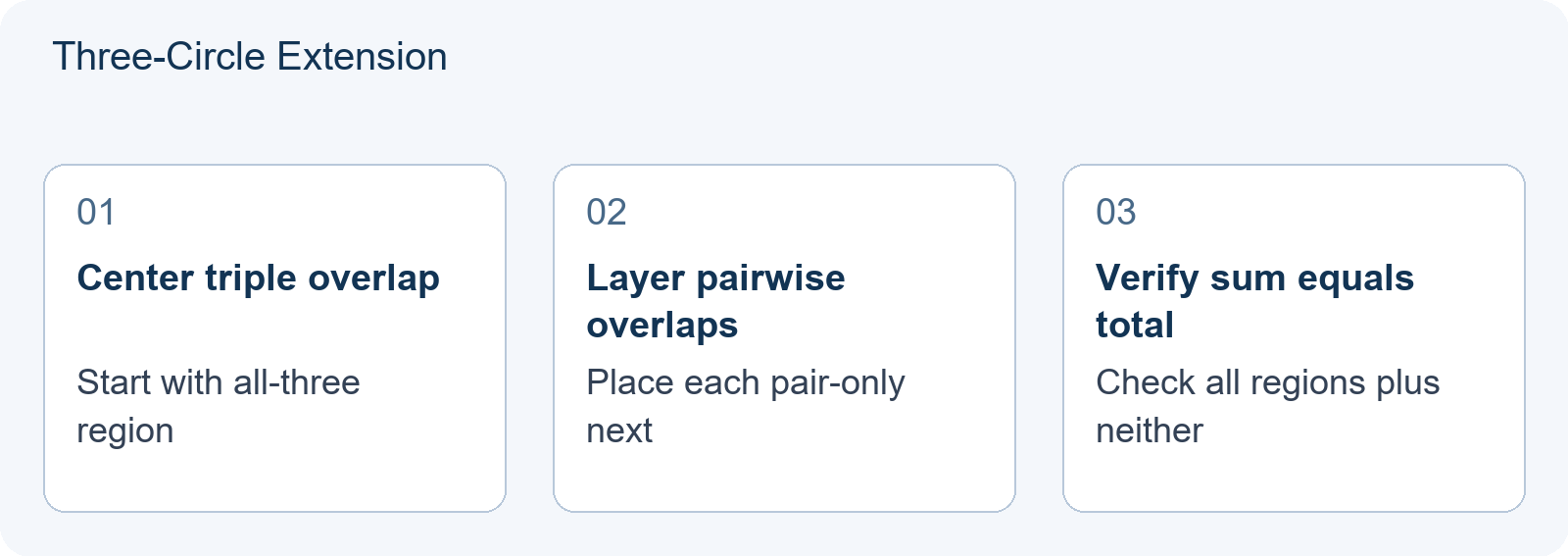
Step 1: Place the triple overlap. Write 5 in the center.
Step 2: Fill pairwise-only regions. These are given as 10, 8, and 6.
Step 3: Fill single-only regions. Given as 20, 25, and 15.
Step 4: Verify total inside circles. Sum = 20 + 25 + 15 + 10 + 8 + 6 + 5 = 89. Add “none” = 11. Total = 89 + 11 = 100 ✓.
Answering the target questions for this 100-student set:
| Question | Regions Included | Answer |
|---|---|---|
| Exactly one subject | Math only + Science only + Coding only | 20 + 25 + 15 = 60 |
| At least one subject | All regions inside any circle | 89 |
| Neither subject | Outside all circles | 11 |
The three-circle case demands more bookkeeping, but the principle is identical: identify every region before summing.
The Common Mistake: Adding Instead of Subtracting the Overlap
A frequent error in two-circle problems is computing “at least one” as Category A + Category B. In Illustration 1, that would give 20 + 15 = 35, which double-counts the 8 students in both. The correct union formula is:
|A ∪ B| = |A| + |B| − |A ∩ B|
Applying it: 20 + 15 − 8 = 27, matching our region-by-region count.
Another subtle error: answering “exactly one” with the total of one category. “Exactly one” is not “basketball players who do not play chess” unless you also add “chess players who do not play basketball.” Both unique regions matter.
Diagnostic Table: Which Formula When?
| Phrase in problem | What to count | Common wrong move |
|---|---|---|
| Exactly one | Sum of all single-only regions | Forgetting one category’s unique region |
| At least one | Total inside all circles (union) | Double-counting overlaps |
| Neither | Total − union | Treating “neither” as zero |
| Both/All three | Innermost overlap only | Including adjacent pairwise regions |
A Targeted Practice Sequence
To build fluency with AMC 8 Venn diagrams, work in this order:
- Label first: Before touching numbers, sketch and name every region. This prevents category confusion.
- Start with two circles: Master the union formula and “neither” subtraction before adding a third category.
- Watch the wording: Circle or underline “exactly,” “at least,” and “neither” in the problem statement before calculating.
- Check consistency: Your inside-circle total plus “neither” must equal the given total. If not, recheck your arithmetic or re-read the problem.
For broader preparation timing, see our AMC 8 Past Papers: Building a Repeatable Diagnostic Cycle With Error Logging. To understand how your results translate into next steps, see our guide on AMC 8 Score: Converting Raw Results Into a Next-Step Decision Framework. For registration details and authorized test center options in China, visit AMC 8 Registration: Which Channel Fits Your Situation Before the 2027 Window Closes.
What to Demonstrate Next
After working through these illustrations, you should be able to: read a Venn diagram problem and immediately classify it by phrase type; compute “exactly one,” “at least one,” and “neither” for two and three sets; and catch double-counting before committing to an answer. The skill transfers directly to AMC 8 counting and probability questions that use similar set language.
Frequently Asked Questions
Does AMC 8 use three-circle Venn diagrams often?
Two-circle problems appear more frequently. Three-circle setups are less common but follow identical logic with more regions to track.
Can I use the inclusion-exclusion formula instead of drawing regions?
Yes, but labeling regions first reduces errors. The formula |A ∪ B| = |A| + |B| − |A ∩ B| is equivalent to summing all inside regions.
What if the problem gives ‘neither’ and asks for the overlap?
Work backward. Subtract ‘neither’ from total to find the union, then use given single-category totals to solve for the unknown overlap.